

Purpose & Scope
Section 03.60.00 covers portland-cement, nonshrink, and epoxy grouts used beneath base plates, machinery pads, and structural support elements. Because grouting quality depends on continuous flow, sealed forms, and timing, a single missed step can undermine bearing performance.The three-phase QAQC flow, Preparatory, Initial, and Follow-Up, keeps these risks under control by verifying readiness before mixing begins, validating the first placement, and ensuring production runs without deviation.
The FTQ360 version captures substrate photos, temperature logs, vent confirmations, and strength results so each placement has an auditable record of bearing integrity from planning through acceptance.
What the Checklist Covers
You use this checklist from pre-installation through curing and strength validation. Early steps confirm approved grout submittals, storage, temperature-control plans, and the configuration of forms, dams, and vent paths.
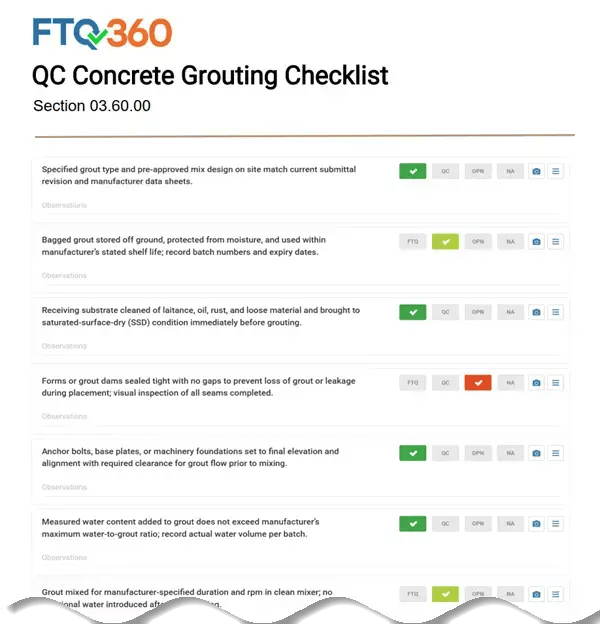
When the first placement begins, the checklist guides you through substrate cleaning, SSD verification, leakproof formwork, water-content control, and mix-sequence confirmation, exactly where most grouting failures originate.
During placement, it walks you through continuous flow from one side, vent discharge, thickness checks, overflow control, and curing initiation.
By completion, inspectors document shim removal, bearing-area inspection, strength testing, and repairs. The result is a complete, location-linked QAQC trail for every grouted support.

Checklist Preview
Click to Download Full Checklist
Common Failure Modes & Risk Prevention
Grouting has recurring field issues because bearing depends entirely on continuous flow, sealed forms, and strict timing.
Most failures originate in the Preparatory or Initial phases, long before the grout visibly sets. Voids under base plates, early-age cracking, insufficient strength, and bond failure each have distinct root causes, recognizable field symptoms, and specific checkpoints tied to the three-phase QAQC process.
Voids beneath base plates
Root cause: Grout begins to stiffen before filling the cavity, forms leak at joints, or crews attempt placement from multiple sides instead of using a single flow direction.
Field indicators: Hollow edges, incomplete vent discharge, vibration under machine startup, visible gaps along plate edges.
FTQ360 Inspection: Preparatory-phase checkpoints document sealed grout dams with photos. Initial-phase fields confirm SSD condition, temperature limits, and the first successful one-direction placement. Follow-Up entries track vent discharge and continuous flow so recurring void patterns become visible in dashboards.
Early-age cracking or shrinkage
Root cause: Excess water for workability, hot or dry weather, or placing grout outside the manufacturer’s temperature range.
Field indicators: Surface checking near edges, shrinkage cracks around anchor bolts, cracking visible during shim removal.
FTQ360 Inspection: Preparatory-phase temperature-control plans link to digital logs in the Initial phase. Required fields validate actual water addition and curing start time. Follow-Up records capture substrate and grout temperature trends across placements, revealing environmental patterns.
Insufficient compressive strength
Root cause: Expired or moisture-contaminated materials, improper water ratio, incomplete mixing, or incorrect epoxy component proportions.
Field indicators: Low 48-hour or 28-day breaks, soft or chalky bearing edges, debonded areas exposed after shim removal.
FTQ360 Inspection: Preparatory-phase confirmations verify shelf life and storage conditions. Initial-phase checkpoints record mix ratios, pot life, and batch identifiers. Follow-Up records link cylinder breaks to placement locations so outliers stand out early.
Bond failure at steel or concrete
Root cause: Contaminated plates, smooth or unprepared concrete substrates, missed SSD condition, or standing water beneath plates.
Field indicators: Rocking plates, hollow zones, visible dark gaps at edges, or anchor movement when torque load transfers.
FTQ360 Inspection: SSD and substrate-prep photos in the Initial phase show conditions immediately before placement. Follow-Up inspections use edge-sounding and temperature logs to document bond integrity. Dashboards surface recurring preparation issues tied to specific crews or locations.
Epoxy grout incompatibility or improper cure
Root cause: Incorrect component ratios, placing outside temperature windows, or exceeding pot life.
Field indicators: Soft spots, cracking around anchor bolts, tacky or uncured surfaces, thermal discoloration.
FTQ360 Inspection: Preparatory entries confirm product limits. Initial-phase fields enforce ratio checks and pot-life timestamps. Follow-Up monitoring logs temperature during cure, catching out-of-range conditions before they affect performance.
Preparatory Phase
Prepare for success by verifying that personnel, materials, equipment, and documentation are ready for work to begin. This includes confirming approved grout submittals, validating shelf life and storage conditions, and reviewing manufacturer temperature requirements.
Preparatory-phase checks for sealed formwork, vent layout, substrate cleaning procedures, and SSD plans directly address the root causes of voids and bond failures. Mechanical thermometers or infrared meters are readied for temperature logging, and inspectors plan the one-direction flow path to prevent grout stiffening during placement.
Before moving forward, all hold-point requirements, including mockups, mix-sequence demonstrations, and material certifications, are documented so the Initial phase begins on solid ground.

Initial Phase
This phase confirms that work starts correctly. Inspectors verify substrate preparation, SSD condition, and the integrity of grout dams before mixing begins, key controls against bond failure and leakage-induced voids.
The checklist directs inspectors through water-content verification, adherence to the manufacturer’s mixing sequence, compliance with pot-life limits, and confirmation of flowability through a trial batch.
During the first placement, inspectors monitor temperature, confirm one-direction flow, and document vent discharge. Any deviation observed here is corrected immediately so production follows a validated standard.
Follow-Up Phase
This phase aims to keep work proceeding correctly. Inspectors track batch-to-batch consistency, temperature trends, vent confirmation, grout thickness, and continuous flow across placements.
These checks directly address recurring patterns identified in the failure modes: early-age cracking traced to weather exposure, voids tied to intermittent flow, or low strength from mixing inconsistencies.
With FTQ360’s linked log entries, inspectors can quickly spot whether issues cluster at specific elevations, plate sizes, or crews and adjust practices before defects multiply.
Completion, Final Acceptance & Closeout
All of the work culminates with a final result; this phase ensures the completed installation meets project requirements. Inspectors verify shim removal timing, inspect bearing areas for cracks or voids, and document any repairs.
Cylinder or cube strength results are confirmed against specified acceptance criteria and linked to placement records in FTQ360. Curing logs, temperature data, and mix records are compiled into a complete closeout package.
With all field quality-control documentation in one location, acceptance reviews proceed with transparency and confidence.
References and Other Specification Systems
References
ACI 301 – Specifications for Structural Concrete;
ACI 318 – Building Code Requirements for Structural Concrete;
ASTM C33; ASTM C40; ASTM C150; ASTM C191; ASTM C307; ASTM C531; ASTM C579; ASTM C827; CRD-C621.
Other Specification Systems
- UFGS 03 61 00 Non-Shrink Grouting
- VA Master Specification 03 60 00 Grouting
- NMS 03 60 00 Grouting
- RIB SpecLink 03 60 00 Grouting
FTQ360 Inspection & QAQC Platform
FTQ360 runs on tablets and phones (online or offline), allowing inspectors to capture photos and measurements at the point of work.
Required fields and conditional logic help prevent skipped steps and enforce hold points during grouting work. Time and user stamps maintain traceability, while lot and location tracking ties each grouting inspection to the correct base plate, equipment pad, structural support, or placement area.
Dashboards reveal patterns such as recurring form leakage, incomplete venting, inconsistent grout flow, poor substrate preparation, missed curing steps, or repeated strength-test failures, so teams can correct issues before they affect multiple installations.
How to Use the Free Template (quick start)
Prefer the FTQ360 in-app setup?
Open Checklist Setup → Library, search for the code and tap to clone the checklist.
Then tailor checkpoint templates to your requirements.
If your team still needs paper in select areas, you can print the PDF from the FTQ360 app, mark it up in the field, then transcribe results and attach photos later, just note that paper won’t enforce required fields, conditional logic, or holds like the app does.
For step-by-step help, visit support.ftq360.com.
MasterSpec® and MasterFormat® are registered trademarks. This blog references section numbers and titles for clarity only and does not reproduce proprietary content. Copyright FTQ360.