
Construction inspection reports are only as strong as the checkpoints that define them. When checkpoints are written with clarity and discipline, a construction inspection report becomes consistent, defensible and genuinely useful for managing risk.
When they are vague or loosely structured, reporting becomes subjective, inconsistent and difficult to enforce.
The quality of a construction inspection report is not determined at the moment it is submitted. It is determined long before the inspector enters the field, when reporting expectations are defined through checkpoint design.
This article explains how well-crafted checkpoints drive better construction inspection reports, reduce reporting ambiguity and strengthen quality control outcomes across projects.
What should a construction inspection report include?
A construction inspection report should clearly document what was inspected, how it was evaluated and whether the defined requirements were met. At minimum, the report must identify the scope of work reviewed, the applicable checkpoints and the inspector’s conclusion for each checkpoint.
Strong construction inspection reports also include any required supporting evidence. If measurements are necessary to confirm compliance, those values should be recorded. If visual confirmation is critical, required photos should be attached.
When reporting requirements are written directly into the checkpoints, the structure of the construction inspection report becomes consistent and enforceable across projects.
Most importantly, a construction inspection report should make it easy for a reviewer to determine whether reporting requirements were satisfied.
The goal is not length. It is clarity. A report is complete when it meets the expectations defined by its checkpoints, no more and no less.
For a deeper look at how inspection reporting requirements fit within a broader governance framework, see how general contractors create ITPs that actually get used.
“If your checkpoints live in spreadsheets and vary by superintendent, your inspection quality will always be inconsistent.”

Consistent construction inspection reports start with clear expectations
Most construction teams want the same thing from construction inspections, reports that are consistent, credible and actually useful for managing risk. When expectations for construction inspection reporting are explicit, inspectors know exactly what is required, reviewers know what to look for and inspection outcomes become predictable.
When expectations are implied or informal, consistency disappears.
The fastest way to improve construction inspection outcomes is not to demand more documentation or tighter oversight in the field. It is to clearly define, up front, what a complete inspection report is expected to contain.
Checkpoints define how construction inspections are reported
Inspection checkpoints are often treated like simple checklist reminders.
In practice, they play a much more important role. In construction inspection programs, checkpoints are how inspection reporting requirements are codified and communicated.
Taken together, they form the operating procedure for how a construction inspection is performed in the field and how results are reported.
A well written checkpoint answers three fundamental questions for the inspector:
-
What am I being asked to verify or report?
-
What information, if any, must I capture?
-
How do I know when this checkpoint is complete?
When those answers are clear, inspections are easier to perform and easier to review. When they are not written directly into the checkpoint text, teams end up relying on assumptions, assumptions that are difficult to train to and impossible to enforce consistently.
If you want to go deeper on improving field inspection discipline overall, read our guide on improving construction site inspection quality.
Verification checkpoints should be statements the inspector agrees with
When a checkpoint is intended to verify conformity, it should be written as a clear statement of compliance. Passing the checkpoint means the inspector is explicitly agreeing with that statement. Declarative phrasing defines the conclusion being asserted, which is essential for the credibility and authority of construction inspection reporting.
Use the word ‘verify’ sparingly. ‘Verify’ refers to the act of verification itself. It does not automatically imply compliance, only that something was checked. Clear conformity statements remove ambiguity and align everyone on what is being reported.
Less effective: Verify anchor bolts.
More effective: Sole plate anchor bolt spacing is ≤ 72 in on center.
In the second example, there is no ambiguity about what passing the checkpoint means. The inspector is asserting that the condition meets the stated requirement. That clarity improves consistency and makes construction inspection results far more defensible.
Strong checkpoints don’t just improve inspections, they improve the quality of your daily construction reports.
When data is required, make it explicit
In many construction inspection scenarios, a simple conformity assertion is not enough. You want confirmation that a specific observation or measurement was actually made. In those cases, the checkpoint should explicitly require the data to be reported.
This approach works best when the inspector must obtain that information anyway in order to assess conformity. Requiring the inspector to record it strengthens the credibility of the conclusion without adding unnecessary work.
Examples:
Record NOAA weather conditions at time of inspection.
Sole plate anchor bolt spacing is ≤ 72 in on center. (record measured spacing)
Here, passing the checkpoint requires that the data be reported. The reporting requirement is explicit, reinforcing that the underlying check was actually performed during the construction inspection.
The most effective checkpoints come from standardized, repeatable construction checklists built around known risk areas.
Use photos deliberately, not automatically
Photos are one of the most powerful tools in construction inspection reporting, but only when their use is deliberate. Requiring photos everywhere adds friction and slows inspections. Assuming photos will be provided leads to inconsistency and confusion during review.
If a photo is required, it should be explicitly stated in the checkpoint text.
Clear photo requirements ensure that inspectors know exactly when photos are expected, reporting is consistent across projects and inspection review can be objective rather than interpretive. Providing example photos during training further reinforces expectations and reduces back and forth during review.
Photos also have a useful side effect. When inspectors know a photo will be required, work is more likely to be examined rigorously. Nobody wants to send photo that shows they made a mistake. In that way, photos do not just document compliance, they help improve accuracy.
The key is balance. Photos should be required where they add clarity, confidence, or preventive value, not everywhere by default.
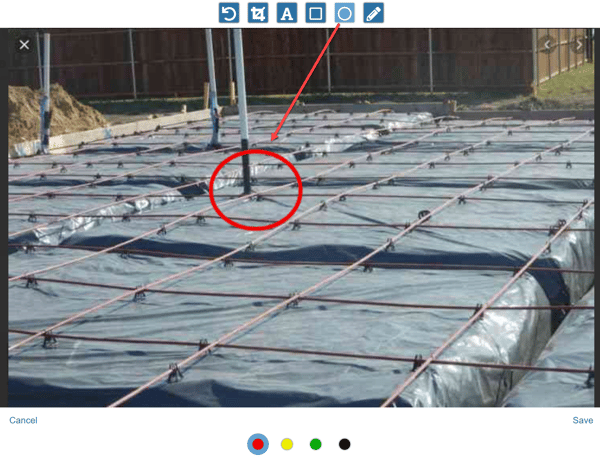
Less effective: Concrete reinforcing spacing is as specified. (record measured spacing)
More effective: Concrete reinforcing spacing is as specified. (record measured spacing and take photo with rule)
Photos show what was inspected and confirms that measurements were actually taken. Time and GPS stamps further strengthen the credibility of the construction inspection record.
When a photo is not explicitly required, its absence should never be treated as a reporting failure.
Inspection review. Quality control for the construction inspection report
Inspection Review is quality control on the construction inspection reporting process itself. Its purpose is not to re inspect the work or second guess field judgment, but to ensure inspection reports meet the expectations defined by the checkpoints.
Rather than asking reviewers to interpret intent, Inspection Review applies a simple test: Did the inspection report satisfy the reporting requirements as written? Were required photos provided? Was required data recorded? Were checkpoint instructions followed exactly as defined?
When reporting deficiencies are identified, Inspection Review creates a practical opportunity to correct them while the inspection is still fresh. Over time, it also improves future inspections. By consistently identifying where reporting did not meet expectations, inspectors are realigned with clear, enforceable standards.
This review function is one of the reasons why ITPs fail in construction — when inspection review is absent, reporting quality drifts and the ITP gradually loses authority.
The underlying message is constructive but firm. How and what you report matters. Reporting quality is monitored, expectations are consistent and inspectors are responsible for correctly carrying out and documenting construction inspections.
When applied consistently, Inspection Review becomes objective, fast and fair and inspection quality improves as a natural outcome of the process.
Focus checkpoints on risk, not volume
Another checkpoint design discipline is restraint. Not every requirement needs to become a checkpoint and adding more checkpoints does not automatically reduce risk.
The purpose of inspection checkpoints is to reduce risk, not to restate every project specification. Drawings and specifications already define the full set of requirements that must be built. Checkpoints exist to ensure the highest risk conditions are consistently checked and reported.
Applying an 80–20 mindset is essential. On most projects, a small number of conditions account for the majority of quality issues, rework and downstream risk. Effective construction inspection programs deliberately focus checkpoints on that critical minority.
When inspections include too many low value checkpoints, attention is diluted. Important checks are buried, inspections feel like make work and reporting loses meaning. Inspectors recognize this immediately.
By keeping checkpoints focused on what truly matters, construction inspections become shorter, clearer and more effective and co-operation improves because inspectors understand the purpose behind the checks.
This same discipline, focusing verification on high-risk gates rather than comprehensive documentation — is what separates an ITP from a checklist for general contractors.
Some checkpoints should function as formal hold or witness points, especially for high-risk work.
Well-crafted checkpoints lead to stronger construction inspection reports
Strong construction inspection reporting does not come from asking inspectors to do more. It comes from designing checkpoints that clearly define what must be verified, what must be reported and what ‘complete’ looks like.
When conformity depends on visual confirmation, measurement, or observation, capturing that information strengthens the conclusion and makes inspections easier to defend. When it does not, a clear conformity statement is often sufficient. Applying this discipline selectively is what keeps construction inspections effective rather than burdensome.
When clear checkpoint design is reinforced through consistent Inspection Review, inspection quality improves as part of the normal workflow, not through escalation or after the fact enforcement. Inspectors know what is required, reviewers can simply follow the rules, training becomes more focused and inspection data becomes more reliable over time.
Most importantly, construction inspections begin to deliver what project teams actually need - consistent, credible information that reduces risk, supports better decisions and reinforces First Time Quality by design.
Want to see how disciplined checkpoint design and Inspection Review work in practice?
FTQ360 helps construction teams standardize inspection expectations, improve construction inspection reporting quality and continuously strengthen performance across projects. If you are serious about getting inspections that consistently deliver value, not just completed checklists, it may be time to take a closer look.

Frequently Asked Questions About Construction Inspection Reports
What is a construction inspection report?
A construction inspection report is a documented record of field verification activities. It identifies what was inspected, which checkpoints were evaluated and whether the inspected work conforms to project requirements.
How do checkpoints improve construction inspection reports?
Checkpoints define what must be verified and how results must be reported. When written clearly, checkpoints eliminate ambiguity and standardize how construction inspection reports are created and reviewed.
What makes a construction inspection report defensible?
A construction inspection report is defensible when it contains three things: a clear conformity statement for each checkpoint, not just "verified" but an assertion that the specific requirement was met; recorded measurements or observations where the checkpoint requires them; and explicitly required supporting documentation, typically photos, attached at the point of inspection. Clarity and consistency are more important than volume. A report that precisely meets its checkpoint requirements is more defensible than a long report that leaves reviewers guessing whether the work was actually checked.
Should every checkpoint require a photo?
No. Photos should only be required when they add clarity, reinforce high-risk conditions, or strengthen documentation credibility. If a photo is required, that requirement should be written directly into the checkpoint.
What should be included in a construction inspection report?
A construction inspection report should identify the scope of work reviewed, the checkpoints evaluated, and the inspector's conclusion for each checkpoint , including whether the work conforms to the stated requirement. Where checkpoints require it, the report should include recorded measurements, observations, and attached photos. It should also record the inspector, the date, and the location. The goal is not a long report, it is a complete one. Complete means every checkpoint requirement was satisfied, every required data point was captured, and every required photo was provided.
What is the difference between a construction inspection checklist and an inspection report?
A checklist is a prompt, it reminds the inspector what to look at. An inspection report is a record , it documents what was found and whether it conforms to requirements. The difference matters because a checklist that was marked 'complete' does not prove compliance. An inspection report with clear conformity statements, recorded measurements, and required photos creates a defensible record that can stand up to client review, regulatory scrutiny, and dispute pressure. Well-designed checkpoints are what turn a checklist into a report.