
Drones for construction inspection are transforming how contractors, quality managers and superintendents verify compliance, reduce safety risk and document work across complex jobsites. They improve safety, reduce the time required to access hard-to-reach areas and make it possible to capture consistent visual records across large or complex jobsites.For many contractors and builders, drones feel like a natural next step in modernizing inspections.
The real opportunity, however, is not simply flying drones over a project. The value comes from understanding how to use drone imagery as part of a disciplined inspection process that verifies compliance with project requirements. Used correctly, drones strengthen inspections. Used in isolation, they risk becoming little more than taking pictures during a jobsite walk.
What Are Drones Used for in Construction Inspection?
Drones are used in construction inspection to capture visual evidence of roofs, façades, structural steel, exterior envelopes, equipment, site conditions, progress, and hard-to-access work areas. Their real QAQC value comes when those images are attached to specific inspection checkpoints, acceptance criteria, and project records.
| Drone inspection use case | What drones help capture | QAQC value |
|---|---|---|
| Roof and façade inspections | Visual condition, installation consistency, damage, missing components | Reduces unsafe access and improves visual records |
| Structural steel inspections | Alignment, visible connection issues, surface conditions, progress | Supports progress verification and visual QAQC checks |
| Exterior envelope inspections | Surface coverage, penetrations, visible installation defects | Helps identify issues before closeout |
| Site progress inspections | Repeatable images from consistent viewpoints | Creates a visual project record over time |
| Elevated equipment inspections | Visible damage, corrosion, labels, access conditions | Reduces downtime and access requirements |
| Repetitive work areas | Repeated visual checks across similar zones | Helps spot patterns and recurring defects |
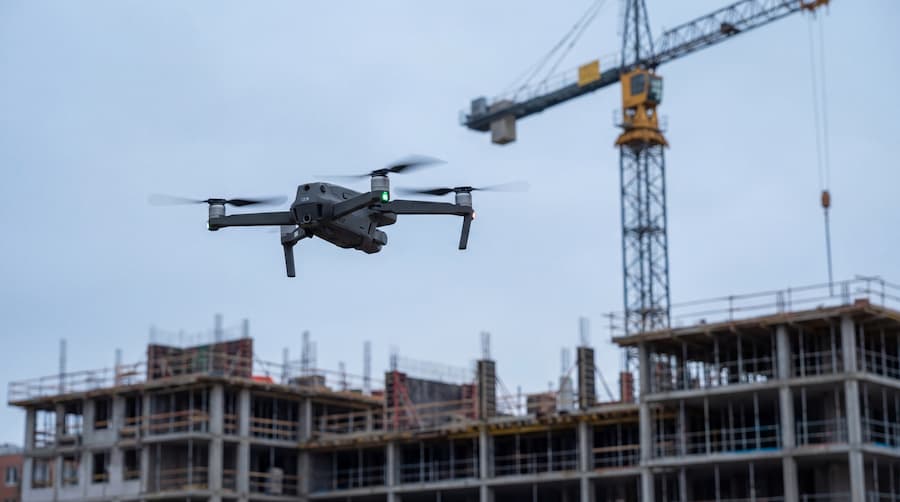
Drone Stock photos by Vecteezy
Why drones strengthen equipment and construction inspections
Drones belong in modern construction and equipment inspections because they remove some of the biggest day-to-day constraints inspectors and superintendents deal with: unsafe access, coordination delays, and limited visibility across large or complex sites.
By reducing the need for lifts, scaffolding, ladders, and roof access, drones lower exposure to fall hazards while making it practical to capture consistent, repeatable visual records of roofs, façades, exterior envelopes, foundations, structural steel, and other hard-to-reach or repetitive scopes.
When integrated into a structured QAQC process, that same visual capture strengthens outcomes in ways traditional walkdowns often can’t match. A single flight can document areas that would otherwise take hours of coordinated access, improving turnaround while minimizing disruption to active work zones, and repeatable viewpoints support more consistent defect detection and progress tracking.
The same advantages extend to equipment inspections, cranes, heavy equipment, elevated mechanical systems, and mounted components can be visually verified with less downtime and better documentation of wear, corrosion, labeling /data plates, alignment issues, and visible damage, while still recognizing the boundary: drones enhance visual verification but can’t replace torque checks, pressure readings, electrical continuity testing, or performance validation.

Inspections still require an agenda
Quality control inspections exist to verify and document compliance with project requirements, but that work operates at two distinct levels. At the project level, inspection plans define which inspection reports are required, for what scope of work and at what stages of construction. These plans establish inspection coverage and expectations across the project lifecycle.
At the inspection-report level, checkpoints provide the agenda. Each checkpoint defines what must be verified within a specific inspection, how verification should occur and what acceptance looks like. These checkpoints are risk-based, focusing attention on the areas most likely to cause defects, rework, or downstream problems.
Every effective drone-supported inspection should align with defined Inspection & Test Plans to ensure coverage and compliance.
Connecting drone imagery to inspection checkpoints
The real challenge with drone inspections is not flying the drone or collecting images. It is connecting those images to inspection checkpoints. Each checkpoint defines a verification requirement and each requirement implies specific evidence needs.
Some checkpoints can be supported effectively by drone imagery, provided the images are captured intentionally. This includes visual requirements such as location, orientation, alignment, spacing, surface coverage and general installation consistency. For these checkpoints, drones can dramatically improve coverage, safety and consistency.
Other checkpoints impose stricter evidence requirements that influence how imagery must be captured. Close-up details such as equipment serial numbers, data plates, labeling, grounding connections and fastener conditions cannot be reliably verified through fly-by imagery. These checkpoints require deliberate flight planning, closer access, or supplemental manual verification.
Many checkpoints are not visual at all. Construction specifications routinely require confirmation of torque values, voltage readings, pressure tests, continuity checks and functional performance criteria. These requirements cannot be satisfied with imagery, regardless of image quality. Drones can support documentation around these checkpoints, but they cannot replace direct measurement and testing.
The practical question is not whether drones can support inspections. The question is which checkpoints can be verified visually, which require close-up evidence, and which still require manual testing or measurement.
| Checkpoint type | Can drone imagery support it? | Example | Inspection limitation |
|---|---|---|---|
| Visual condition | Yes | Surface damage, corrosion, missing components, incomplete work | Image must show enough detail |
| Location and orientation | Yes, if reference points are visible | Equipment placement, panel alignment, façade sections | May need drawings or location tagging |
| Spacing and coverage | Sometimes | Repetitive installations, exterior envelope coverage, roof areas | Scale must be clear |
| Labels and data plates | Sometimes | Equipment labels, serial numbers, visible markings | Requires close-up image quality |
| Fastener or connection condition | Sometimes | Missing bolts, visible connection issues, damaged fixings | Cannot confirm torque or hidden defects |
| Torque, pressure or electrical readings | No | Torque checks, pressure tests, continuity tests | Requires direct measurement |
| Functional performance | No | Equipment startup, system performance, commissioning tests | Requires testing and qualified assessment |
The first gate. Are drone images fit for inspection?
In practice, every inspection includes a mix of checkpoint types. Some are well suited to drone-supported verification, some require close-up visual confirmation and others require manual measurement or testing. Every checkpoint still must be verified. Drone imagery becomes inspection evidence only when it is intentionally captured to meet the evidence requirements of the checkpoint. Without that connection, images remain general documentation with limited QAQC value.
Before assessing conformance, inspectors must determine whether an image is even usable for inspection. An inspectable image must show the correct work feature, the correct phase of work, the correct location and the right level of detail. Orientation, angle, resolution and reference points all matter and these considerations should inform how drone flight patterns are planned.
This distinction is critical. Image clarity does not equal inspectability. A high-quality image can still fail inspection needs if it does not show the specific detail required by the inspection checkpoint.
How to tell whether a drone image is inspection-ready
A drone image should not be accepted into the QAQC record simply because it is clear. It should be assessed against the inspection purpose. If the image does not support the checkpoint, it should be treated as general documentation, not inspection evidence.
| Inspection-readiness question | Why it matters |
|---|---|
| Does the image show the correct work feature? | Prevents teams from attaching irrelevant jobsite photos to inspection records |
| Does it show the correct phase of work? | Avoids using images taken too early or too late to verify the checkpoint |
| Is the location clear? | Makes the evidence traceable to the project area, floor, elevation, gridline or work zone |
| Is the level of detail sufficient? | Determines whether the inspector can verify the actual requirement |
| Are reference points visible? | Helps assess alignment, spacing, orientation and scale |
| Is the image linked to the right checklist item? | Turns the image into structured QAQC evidence |
| Is manual verification still required? | Prevents visual evidence from replacing required tests or measurements |
Using drone images for compliance verification
Once images pass the content gate, they can support meaningful QAQC inspection goals. Drone imagery can be used to assess alignment, spacing, surface coverage, installation consistency and dimensional relationships. For repetitive work, images also enable trend analysis that is difficult to achieve through spot checks alone.
When a drone cannot directly assess conformance, a practical compromise is to use the drone to capture the required image and have a qualified expert manually assess compliance. This approach delivers immediate value while laying the groundwork for future automation. In all cases, acceptance criteria come from project specifications, not from images. Images support verification; they do not define compliance.
A credible inspection process requires a combination of drone-supported and manual verifications results in an accurate and complete inspection
Drone construction inspection workflow
A drone construction inspection should follow the same discipline as any other QAQC inspection. The flight plan, image capture and reporting process should be driven by the inspection requirement, not by the drone operator’s preference for general site footage.
| Step | Action | QAQC output |
|---|---|---|
| 1 | Define the inspection scope | Clear list of work areas, systems or activities to inspect |
| 2 | Identify drone-supported checkpoints | Separation of visual, close-up and manual-verification requirements |
| 3 | Link checkpoints to the ITP or checklist | Inspection evidence is tied to project requirements |
| 4 | Plan the flight path | Images are captured from useful angles and locations |
| 5 | Capture image or video evidence | Visual record of the work condition |
| 6 | Attach evidence to the correct checkpoint | Drone media becomes part of the inspection record |
| 7 | Mark the inspection outcome | FTQ, open, fixed, not applicable, or failed inspection |
| 8 | Assign deficiencies where needed | Responsible parties receive corrective actions |
| 9 | Store the completed inspection record | Evidence is available for reporting, closeout and compliance |
This workflow prevents the most common failure in drone-supported construction inspections: collecting large volumes of media that are not connected to any inspection decision. The goal is not more footage. The goal is better evidence.
An easy way to get started using drone inspections within a QAQC framework
Most construction companies do not move to drone-supported inspections all at once. Adoption typically begins with small experiments or proof-of-concept efforts focused on specific scopes of work or hard-to-access conditions. As confidence and credibility grow, the use of drone imagery naturally expands.
FTQ360 supports this evolution by anchoring inspections in structured digital checklists and Inspection & Test Plans from the start. Verification requirements are defined first, allowing teams to decide which checkpoints can be supported by drone imagery, which remain manual and how that balance changes over time.
As drone usage increases, FTQ360 links imagery directly to inspection checkpoints, inspection records and verification outcomes. Drone images become inspection evidence, not standalone files. Manual measurements, test results and expert assessments can all be combined with imagery into a single, auditable inspection record.
By supporting mixed inspection methods and gradual adoption, FTQ360 helps construction companies scale drone usage responsibly while maintaining inspection credibility and strengthening their path to First Time Quality.
How FTQ360 turns drone images into auditable QAQC records
Drone software can help capture, map and manage visual media. FTQ360 plays a different role. It gives construction teams the QAQC system of record needed to connect drone imagery to inspections, checklists, ITPs, deficiencies, corrective actions and closeout documentation.
| Without structured QAQC | With FTQ360 |
|---|---|
| Drone images sit in folders or file libraries | Images are attached to specific inspection checkpoints |
| Media is disconnected from project requirements | Evidence is linked to checklists and ITP items |
| Defects still need to be manually chased | Deficiencies can be assigned, tracked and closed out |
| Photos show what was seen but not what was verified | Inspection outcomes are documented against acceptance criteria |
| Closeout records require manual assembly | Completed inspection records are stored in one auditable system |
Using drones to strengthen construction quality inspections
Drones can significantly improve the efficiency, effectiveness and consistency of construction inspections. They make it possible to capture images that would otherwise be unsafe, impractical, or inefficient to obtain.
At the same time, drones alone do not constitute a complete quality control process. Quality still depends on planned inspections, defined acceptance criteria and documented verification of both visual and non-visual requirements. When used within a disciplined, digital QAQC framework, drones are best understood as an inspection multiplier, a powerful tool that strengthens quality control rather than replacing it.
Frequently Asked Questions About Drones for Construction Inspection
What are drones used for in construction inspection?
Drones are used to capture visual evidence of construction work, especially in areas that are difficult, unsafe or inefficient to inspect manually. Common examples include roofs, façades, structural steel, exterior envelopes, elevated equipment, site progress and large repetitive work areas.
Can drone images be used as QAQC evidence?
Yes, but only when the image is tied to a specific inspection checkpoint, location, work feature and acceptance requirement. A drone image without that context is general documentation, not QAQC evidence.
What is the difference between drone inspection software and construction inspection software?
Drone inspection software helps capture, map or analyze drone imagery. Construction inspection software manages the QAQC workflow, including checklists, ITPs, deficiencies, approvals, corrective actions and closeout records.
Can drones replace construction inspection checklists?
No. Drones can provide visual evidence, but checklists define what must be verified. The best workflow uses drones to support checklist checkpoints, not replace them.
How should drone inspections connect to an Inspection and Test Plan?
Drone-supported checkpoints should be mapped to the relevant Inspection and Test Plan items. This ensures the imagery supports planned inspections rather than becoming disconnected project media.
Do drones replace manual construction inspections?
No. Drones enhance visual verification but cannot replace physical measurement, testing, or performance validation.
Are drones effective for construction equipment inspections?
Yes. Drones improve safety, reduce downtime and enhance documentation quality for heavy equipment and elevated systems.
What types of construction equipment can drones inspect?
Cranes, structural steel, rooftop mechanical systems, mounted equipment, exhaust stacks and installed machinery.
Do drones reduce inspection costs?
They often reduce labor time, equipment rental and rework costs by improving early defect detection.