

Purpose & Scope
The HB.03.00 Drywall and Paint Punch checklist helps production homebuilders verify that interior gypsum board, texture, primer, paint, and finish touch-up conditions are ready before owner-ready acceptance. This checklist addresses surface defects, cracks, corner bead, fastener pops, paint coverage, color consistency, trade damage, cleanliness, and documented correction closure.
For a production builder, drywall and paint punch is not just a cosmetic review. It is one of the last major opportunities to control homeowner-visible quality before walkthrough, closing, and warranty exposure. Drywall seams, lighted walls, rough cut-ins, texture mismatch, paint contamination, unfinished trim interfaces, and poor touch-up work are the kinds of defects buyers notice immediately. They also create reinspection load, trade disputes, superintendent distraction, and late-cycle schedule friction.
The checklist gives the superintendent, QA team, and trade partners a structured way to confirm that finish standards are understood, lot-specific selections are correct, defects are tagged by location, responsible trades are assigned, corrections are documented, and no open drywall or paint conditions remain before the home moves into owner-ready release.
Checklist Preview
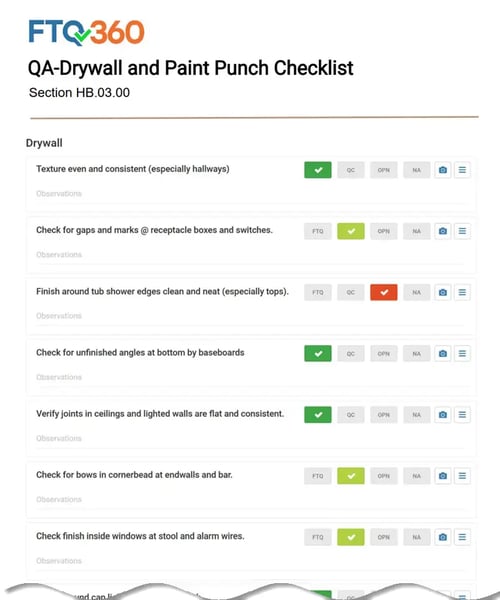

What the Checklist Covers
This checklist begins with information needed to evaluate drywall and paint punch readiness. The current selection sheet, approved paint colors, sheen, door and shutter color, and builder finish standards should be available by lot before punch begins. The inspection record should attach the selection reference so color, finish, and touch-up decisions are checked against the correct lot-specific information.
The checklist then separates responsibilities by trade so defects do not become unresolved handoff disputes. Drywall, paint, trim, cabinet, electrical, plumbing fixture, and exterior finish responsibilities should be identified before inspection. Rooms, elevations, and areas are mapped to the lot plan so defects can be tagged by location. The record should require room or area identifiers, location-tagged photos, defect category, responsible trade partner, correction owner, and reinspection status.
Lighting readiness is also part of the checklist. Finish defects are often missed when the review occurs under poor lighting. Natural light and installed or temporary lighting should be sufficient to reveal wall, ceiling, cut-in, and lighted-wall conditions. The checklist requires a readiness photo so the finish review is not based on a low-visibility walk.
The physical inspection covers room-by-room drywall and paint conditions. Texture should be even and consistent, especially in hallways. Ceiling joints and lighted walls should appear flat and consistent. Walls and ceilings should be clean and free of trash. Receptacle boxes, switches, can lights, tub and shower edges, windows, stool areas, alarm-wire locations, baseboards, crown, casing, closet shelving, quarter round, doors, hardware, hinges, cabinets, exterior cladding, front doors, shutters, exterior painted items, and weatherstripping are all reviewed for clean finish, proper cut-ins, paint contamination, gaps, marks, and visible correction residue.
The checklist closes with owner-ready release conditions. All drywall, texture, paint, cut-in, caulk, trim, door, hardware, cabinet, exterior paint, and weatherstrip checkpoints should pass or be closed with correction evidence. The paint kit should be left in the designated laundry-room location and verified against approved color selections. Open defects that affect homeowner walkthrough, closing readiness, warranty exposure, or defect severity perception should not advance to owner-ready release.
Why This Stage Matters for Production Builders
Drywall and paint punch matters because it sits close to the homeowner experience. Earlier construction defects may be hidden behind systems, assemblies, and finishes, but paint and drywall defects are directly visible during walkthrough. A buyer may not know which trade caused a gap at a device box, a rough tub edge, a bowed corner bead, or a lighted-wall touch-up mismatch. They only see that the home does not look finished.
The production risk is amplified by repetition. The same trade partner, crew, paint method, lighting condition, texture approach, or touch-up habit can repeat across rooms, plans, lots, and communities. If a builder catches the pattern early, the correction can be contained. If it is discovered late, the result can be multiplied rework across a release group, compressed superintendent time, delayed closing readiness, and avoidable warranty concentration.
This is why HB.03.00 should be treated as a stage-release control for owner-ready quality. The home should not advance because the punch walk has been performed. It should advance because the failed items have been corrected, re-inspected, documented, and closed. A clean drywall and paint punch record protects homeowner confidence, reduces late-stage defect counts, improves trade accountability, and helps the builder prevent one finish problem from becoming a recurring production issue.
Common Failure Modes & Risk Prevention
Uneven texture, visible joints, and lighted-wall defects often come from inconsistent application, poor sanding, or spot touch-up where a wider reroll is required. These failures are highly visible during homeowner walkthrough because lighted walls and hallways reveal surface variation. Prevention begins with a first-room finish review that verifies texture consistency, flat ceiling and wall joints, corner bead condition, baseboard angles, and cleanliness against the builder finish standard. Room photos under review lighting should be captured before wider release continues.
Paint color, sheen, or touch-up mismatch usually begins with outdated selections, the wrong paint kit, or an unapproved touch-up method. The result is obvious patching, closing friction, and warranty callback risk. The checklist requires the first paint selection check to confirm color and finish against the current selections and paint kit. A selection reference and paint-label photo should be attached before broader correction work proceeds.
Gaps, rough finish, or poor interfaces at receptacle boxes, switches, can lights, tub and shower edges, windows, baseboards, and alarm-wire locations often come from weak trade interface coordination. These conditions can become trade disputes late in the schedule because drywall, paint, electrical, plumbing, trim, and cabinet work all meet at finish edges. Prevention depends on separate interface checks by trade, close-up location-tagged photos, and clear assignment of the responsible trade partner before final sign-off.
Paint, texture, or overspray contamination on cabinets, hardware, hinges, cladding, weatherstripping, or other finished surfaces usually results from inadequate protection during correction work. This creates damaged finishes, functional issues, and homeowner dissatisfaction. The checklist requires protection and cleanup checks during work so cabinets, hardware, hinges, weatherstripping, exterior cladding, and finished surfaces remain clean and usable after corrections.
Recurring finish defects across similar rooms, plan types, lots, or communities are one of the most important production risks. A repeated drywall or paint method can spread quickly before the builder recognizes the pattern. The checklist requires repeated finish defects to be tracked by room type, plan type, community, and trade partner. When the same defect appears in a first area, comparable rooms and active lots should be checked before additional owner-ready release proceeds.
Before Work Advances
Before drywall and paint punch can be evaluated, the builder needs the right information, lighting, location control, and correction workflow in place. The current selection sheet, approved paint colors, sheen, door and shutter color, finish standards, and lot-specific references should be available before the punch begins. If the inspection starts from the wrong selection information, the punch process can create new defects instead of closing them.
The inspection area should also be ready for a meaningful finish review. Rooms, elevations, and areas should be mapped to the lot plan so every defect can be assigned to a specific location. Lighting should be sufficient to reveal finish conditions, including natural light and installed or temporary lighting where needed. The inspection record should include readiness evidence so later correction decisions are tied to the conditions under which the defects were observed.
Trade responsibilities should be separated before the review begins. Drywall, paint, trim, cabinet, electrical, plumbing fixture, and exterior finish defects may appear in the same room, but they do not always belong to the same correction owner. The checklist should make it clear which trade partner owns each failed condition, how closure evidence will be documented, and what reinspection status is required before the home can move toward owner-ready release.
This setup step does not create a separate production milestone. It confirms that the lot is ready for an effective drywall and paint punch review, with the right selections, lighting, location tracking, responsible trades, and no-advance rule in place for unresolved finish defects that affect homeowner walkthrough, closing readiness, or warranty exposure.
Job-Ready Verification
Job-ready verification confirms that prerequisite information and handoff conditions are acceptable before the current stage proceeds. For HB.03.00, this means the builder verifies that the first reviewed areas demonstrate the finish standard, selection accuracy, interface quality, and correction expectations needed before the broader punch process expands across the home.
The first inspected room should confirm texture consistency, flat ceiling and wall joints, corner bead condition, baseboard angles, and cleanliness against the builder finish standard. Representative photos should be captured so the standard is visible in the record. If the first room reveals uneven texture, visible joints, poor baseboard angles, or unresolved cleanup, the broader owner-ready release process should not assume the rest of the home is acceptable.
The first paint selection check should confirm color and finish against the current selections and paint kit. The selection reference and paint-label photo should be attached before wider touch-up proceeds. This protects the builder from completing correction work with the wrong color, wrong sheen, or wrong touch-up method.
The first device and fixture interface review should confirm that receptacle boxes, switches, can lights, tub and shower edges, windows, and alarm-wire areas are clean and smooth. The first trim and door interface review should confirm that cut-ins at crown, base, casing, quarter round, shelving, door edges, hardware, and hinges are clean. Close-up photos and room-level photos help assign defects to the correct trade partner before the correction process spreads through the home.
Any repeated defect in the first reviewed area should trigger review of comparable rooms or active lots before additional owner-ready release. Job-ready verification is the builder’s early control point for preventing a finish problem from replicating through the release group.
Progress Preview
During active drywall and paint correction, progress preview checks help the builder find issues while they are still easier to correct. These checks are useful, but they do not authorize owner-ready release by themselves. Their purpose is to reduce surprises at the final stage-release decision.
As corrections proceed room by room, each failed location should receive a defect category, responsible trade partner, correction owner, photo evidence, and reinspection status. Lighted walls should be rerolled where required rather than only spot touched up. Before-and-after photos should be captured for each lighted-wall correction so the record shows whether the visible condition was actually corrected.
Progress preview checks should also control protection and cleanup during correction work. Overspray, splatter, paint contamination, caulk smear, and drywall compound should not be allowed to migrate onto cabinets, hardware, hinges, weatherstripping, cladding, or finished surfaces. Cut-ins at trim, casing, crown, base, tubs, showers, can lights, and device openings should remain crisp, sealed where required, and free of gaps or smear.
The progress preview also creates early visibility into patterns. If repeated defects appear by room type, plan type, community, or trade partner, the builder can review comparable areas in the release group before the same issue reaches homeowner walkthrough. This protects superintendent capacity and allows trade partner coaching to occur before defects become closing or warranty problems.
Stage Release & Owner-Ready Acceptance
Stage release is the governing inspection event for HB.03.00. The home is ready for owner-ready acceptance only when the required drywall and paint punch conditions have passed, failed items have been corrected, and the inspection record supports advancement.
The final release record should confirm that texture is even and consistent, especially in hallways. Ceiling joints and lighted walls should be flat and consistent. Walls and ceilings should be clean and free of trash. Corner bead should be free of visible bows at end walls and bar areas. Baseboard angles, bar areas, window stool areas, alarm-wire locations, can lights, receptacle boxes, switches, tub and shower edges, crown, base, casing, quarter round, closet shelving, and trim-to-wall locations should be checked for gaps, marks, rough finish, cut-in quality, caulking, and cleanliness.
The release should also confirm paint and finish conditions. Correct paint and finish should match the approved selections. Walls should be clean and pointed up. Lighted walls should be rerolled where required and not merely touched up. Door finish should be smooth and well painted on all sides. Hardware and hinges should be clean and free of paint. Cabinets should have no paint contamination. Exterior cladding should have no paint contamination. Front door paint should match the approved shutter color where applicable, and other exterior painted items should be painted thoroughly. Weatherstripping should be installed on all doors and free of paint. The paint kit should be left in the laundry room and verified for correct color.
If a checkpoint fails, the record should identify the room or area, defect category, responsible trade partner, correction owner, correction evidence, and reinspection result. Open drywall or paint defects that affect homeowner walkthrough, closing readiness, warranty exposure, or defect severity perception should stop owner-ready release until corrected.
For production builders, the release record also becomes trend data. When failures are tracked by room type, plan type, community, lot, trade partner, and defect category, the builder can see whether a drywall or paint issue is isolated or beginning to repeat. That visibility helps prevent late-stage finish defects from spreading across a release group and becoming a larger closing-readiness or warranty exposure problem.
References and Related Specification Systems
References
Primary reference inputs for this checklist include the current builder finish standards, lot-specific selection sheets, paint product data, color schedule, approved paint kit requirements, and current lot-specific selection versions. Local residential code and jurisdictional requirements may also apply where interior finish, door operation, smoke and carbon monoxide device surroundings, or exterior weather protection conditions are affected. Project-adopted editions and local applicability should be verified before treating those references as controlling requirements.
Related Specification Systems
Related specification systems may include Division 09 gypsum board finish, interior painting, paint coating, architectural finish acceptance, and exterior painting. UFGS, VA Master, NMS, and RIB SpecLink equivalents should be verified against the project-adopted sections where required. The Homebuilder checklist does not assume a direct one-to-one commercial specification counterpart. Applicability should be confirmed against the builder’s standards, jurisdiction, project documents, and lot-specific conditions.
FTQ360 Inspection & QAQC Platform
FTQ360 helps production builders manage drywall and paint punch inspections as repeatable owner-ready stage-release controls. Inspectors can complete the HB.03.00 checklist on phones or tablets, tag defects by room and area, attach location-tagged photos, assign responsible trade partners, document correction ownership, record reinspection status, and capture superintendent or QA signoff before the home advances.
Required fields, photo evidence, correction assignments, and reinspection status help prevent release decisions from depending on memory, verbal updates, or informal punch notes. Time stamps and user stamps show who verified the home and when. Community, lot, plan type, room type, trade partner, crew, defect category, and recurrence data make repeated drywall and paint issues easier to see before they spread across the production cadence.
For homebuilders, the value is not simply replacing a paper punch list. The value is knowing which homes passed, which rooms failed, which corrections remain open, which trade partners own each item, which homes are ready for homeowner walkthrough, and where recurring finish risk is emerging before it affects closing readiness, warranty exposure, or homeowner confidence.
How to Use the Free Template
For the fastest digital setup, open FTQ360 Checklist Setup, go to the Library, search for HB.03.00 Drywall and Paint Punch, and clone the checklist.
Then tailor the checkpoint templates to your builder finish standards, selection workflow, room and area naming conventions, plan types, community requirements, trade responsibilities, required photo documentation, and owner-ready release process.
If your team still uses paper in selected areas, the checklist can also support field markup and later transcription. Paper can capture observations, but it cannot enforce required fields, correction ownership, photo evidence, reinspection status, release status, or recurring-defect visibility the way a digital QAQC workflow can.
For step-by-step help, visit support.ftq360.com.
FTQ360 inspection and QAQC software helps homebuilders verify job readiness, make disciplined owner-ready release decisions, prevent repeat finish defects, strengthen trade partner accountability, and protect closing readiness through consistent field evidence.
MasterSpec® and MasterFormat® are registered trademarks. This blog references related specification systems for clarity only and does not reproduce proprietary content. Copyright FTQ360.