

Purpose & Scope
The HB.02.00 Slab Foundation Pre-Pour checklist helps production homebuilders verify that a lot is ready for concrete placement before slab conditions become concealed. This checklist addresses pre-placement verification of foundation layout, forms, reinforcement, vapor retarder, embeds, anchor bolts, MEP sleeves, termite protection where required, elevations, waste-line fall, pipe support, backfill, underpinning, and required inspection release.
For a production builder, the slab pre-pour stage is a release decision. The question is not whether the pour is on the schedule. The question is whether the lot is ready to advance without carrying unresolved quality risk into a concealed condition. Once concrete is placed, many of the most important conditions are no longer visible. A riser in the wrong location can become a fixture conflict. An unsupported waste line can become a settlement, line-movement, or callback issue. A torn vapor barrier can become a moisture concern. A layout or elevation miss can affect framing, finishes, closing readiness, warranty exposure, and homeowner-visible quality.
The checklist gives the superintendent, QA team, and trade partners a structured way to confirm that the current plan is being used, required materials and conditions are in place, municipal or third-party release is documented where required, failed items are corrected, and the lot is ready for concrete placement.
Checklist Preview

What the Checklist Covers
This checklist begins with the information needed to evaluate slab foundation pre-pour readiness for the current lot. The current plan set, slab and foundation details, approved plot plan, trade rough-in drawings, jurisdictional inspection requirements, and applicable builder standards should be available at the lot. The inspection record should identify the document revision and date so layout, footing, vapor barrier, reinforcement, riser, and release conditions are checked against the correct information.
The checklist also confirms that responsibilities are clear before the lot is advanced. Lot layout, formwork, footing condition, vapor retarder, reinforcement, sleeves, riser protection, termite treatment where required, and municipal or third-party inspection coordination should each have an assigned responsible trade partner. Required materials should be on site and protected, including forms, vapor barrier, reinforcement, wire mesh, anchor bolts, embeds, sleeves, riser protection, and termite treatment materials where applicable.
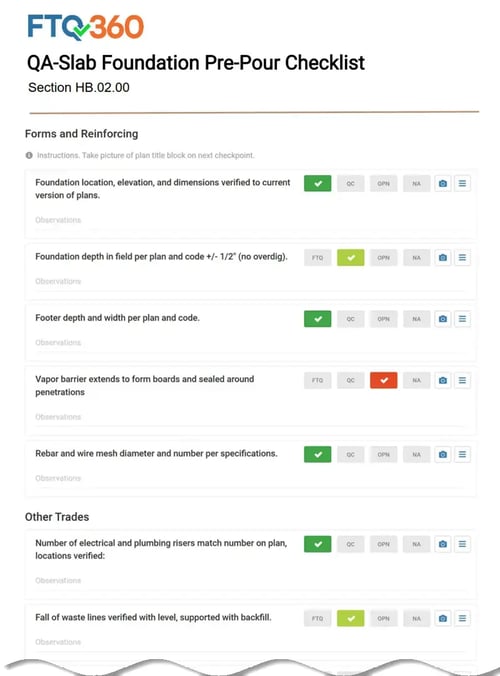
The physical inspection focuses on the conditions that must be verified before the pour. Foundation location, elevation, dimensions, depth, and footing width are checked against the current plans and applicable requirements. Vapor barrier continuity is verified to the form boards and around penetrations. Rebar and wire mesh diameter, count, placement, and support are confirmed. Electrical and plumbing risers are checked for plan count and location. Waste-line fall is verified with a level, and piping support, backfill, and underpinning are checked where needed.
The checklist closes with the release conditions for concrete placement. Municipal or third-party pre-pour inspection status is recorded where required. Open corrections are assigned to the responsible trade partner, corrected, photographed, and reinspected. The completed record should clearly show whether the lot is released for concrete placement or whether the pour must wait until failed conditions are corrected.
Why This Stage Matters for Production Builders
Slab foundation pre-pour matters because it occurs immediately before concealment. The work being reviewed affects structure, under-slab services, moisture control, fixture locations, drainage paths, trade coordination, and downstream production flow. These are not minor observations. They are conditions that can become difficult to see, difficult to prove, and expensive to correct after the slab is placed.
The production risk is multiplied by repetition. Production builders repeat plans, details, scopes, trade partners, crews, community conditions, and lot-start sequences. When the process is controlled, that repetition creates consistency and speed. When a pre-pour condition is missed, the same defect can replicate across multiple lots before the pattern is recognized.
That is why HB.02.00 should be treated as a stage-release control, not a paperwork exercise. A lot should not advance because concrete has been ordered. It should advance because the visible pre-pour conditions support placement. A disciplined release record protects superintendent capacity, reduces avoidable rework, strengthens trade accountability, and lowers the risk that concealed defects become closing delays, warranty claims, or homeowner-facing problems later.
Common Failure Modes & Risk Prevention
Foundation layout and elevation failures often begin with the wrong plan revision, weak layout control, or failure to verify the benchmark before full forming continues. The result can be slab conflicts, rough-in conflicts, downstream alignment problems, or failed inspection. Prevention starts with confirming the current plan, benchmark, first form line, and slab or footing corner before the lot moves deeper into pre-pour preparation. The inspection record should include location-tagged photos and measurement evidence tied to the lot.
Footing and foundation depth or width deficiencies can come from excavation error, forming error, overdig, or uncontrolled backfill. These conditions must be checked before concrete placement because they become much harder to evaluate after the pour. Where the checklist states the acceptance condition, foundation depth is verified per plan and code at plus or minus 1/2 inch with no overdig. Footer depth and width are also checked against the plan and code before release.
Vapor barrier failures commonly occur at edges, seams, sleeves, and penetrations. A vapor barrier may appear acceptable early, then become torn or displaced by reinforcement placement, trade traffic, or riser work. The checklist requires the vapor barrier to extend to the form boards and be sealed around penetrations before placement proceeds. Damaged areas should be repaired and photographed before reinforcement or concrete blocks visibility.
Reinforcement and wire mesh issues include missing steel, wrong diameter, incorrect count, displacement, or poor support. These failures are especially important because the condition is concealed by the slab. The checklist requires rebar and wire mesh diameter and number to match specifications, with placement and support maintained through the pre-pour walk. Missing or displaced steel should stop release until corrected.
MEP riser and waste-line failures include wrong count, wrong location, improper fall, poor protection, or unresolved plan conflicts. These misses can lead to slab sawcuts, fixture relocation, failed inspection, callbacks, or warranty exposure. The checklist requires electrical and plumbing risers to match the plan count and location. Waste-line fall is verified with a level, and lines must be supported with backfill to prevent displacement.
Pipe undermining and voids under the slab create another release risk. Incomplete backfill or missing underpinning can leave piping unsupported below the slab. The checklist requires backfill and underpinning under pipes where needed so concrete is not placed over a condition that may settle, move, crack, or create a callback later.
Before Work Advances
Before the slab pre-pour condition can be released, the builder needs the task-specific setup in place. The current plan set, slab and foundation details, approved plot plan, trade rough-in drawings, jurisdictional pre-pour inspection requirements, and builder standards should be available at the lot. The inspection should be opened by lot and community so the record is traceable to the correct home, plan type, and production stage.
Responsibilities should also be clear before the inspection proceeds. The parties responsible for layout, formwork, footing condition, vapor retarder, reinforcement, sleeves, risers, termite treatment where required, backfill, underpinning, and municipal or third-party inspection coordination should be identified. Required materials and components should be on site and protected before the release review begins.
This setup does not re-approve prior construction stages. It confirms that the information, materials, responsibilities, visible predecessor conditions, and release inputs needed for the slab pre-pour decision are available, current, and trustworthy. If the lot does not have the right documents, layout control, materials, inspection status, or responsible-party clarity, the pour is not ready to be released.
Job-Ready Verification
Job-ready verification confirms that prerequisite work and handoff conditions are acceptable before the current stage proceeds. For HB.02.00, this means the slab pre-pour review begins by confirming that the visible predecessor conditions needed for layout, forming, reinforcement, rough-in coordination, and concrete placement are ready to support the release decision.
The elevation benchmark and layout control should be established for the lot. The tool or equipment used to verify elevation should be identified in the inspection record. The first form line and slab or footing corner should be checked against the current plan before full forming continues. Foundation and footing conditions should be verified against the plan and applicable requirements while they remain visible.
Under-slab trade work also affects job readiness. Plumbing and electrical risers should be counted, located, upright, and protected. Waste lines should maintain required fall, and piping should be supported with backfill. Backfill and underpinning under pipes should be complete where needed so the slab is not placed over unsupported conditions.
Vapor barrier and reinforcement conditions should also be visible enough to verify before the lot advances. The first vapor barrier seam or penetration condition should extend to the form boards and be sealed. The first reinforcement or wire mesh area should match the required diameter and count and be supported or positioned for placement. These early confirmations help the builder avoid discovering release failures only after the pour has already been scheduled.

Progress Preview
During active pre-pour preparation, field checks can be used as a progress preview of the final stage-release inspection. These checks are valuable because they surface issues while corrections are still practical, but they do not authorize advancement by themselves. Their purpose is to reduce surprises at release.
As formwork, rough-in, vapor barrier, reinforcement, and pipe-support work progresses, the superintendent or QA reviewer can look for conditions likely to fail the final release. Foundation location, elevation, dimensions, depth, and footing width can be checked by area. Vapor barrier tears can be repaired before they are covered. Missing or displaced reinforcement can be corrected before the final walk. Riser conflicts can be resolved before concrete trucks are dispatched.
The progress preview also helps identify repeating problems. If the same layout, vapor barrier, reinforcement, riser, or pipe-support issue appears on more than one lot, the builder can check whether the pattern is tied to a plan type, community condition, trade partner, crew, detail, or release sequence. That early visibility helps prevent one failed checkpoint from becoming a production-wide defect pattern.
Stage Release & Concrete Placement Readiness
Stage release is the governing inspection event for HB.02.00. The lot is ready for concrete placement only when required pre-pour conditions have passed, required release status is documented, failed items have been corrected, and the inspection record supports advancement.
The release record should confirm that foundation location, elevation, dimensions, depth, and footing width have been checked against the current plans and applicable requirements. The vapor barrier should extend to the form boards and be sealed around penetrations. Rebar and wire mesh should match required diameter and count. Electrical and plumbing risers should match the plan count and location. Waste-line fall should be verified with a level, and lines should be supported with backfill. Backfill and underpinning under pipes should be complete where needed.
The release should also confirm task-specific conditions that affect concrete placement readiness. Municipal or third-party pre-pour inspection status should be recorded as pass or release where required. Termite treatment or required soil treatment should be complete where applicable, with a treatment record or location-tagged photo attached. Anchor bolts, hold-downs, embeds, blockouts, sleeve penetrations, and slab depressions should match the current plans. Form boards should be stable, clean, aligned, and free of debris, standing water, or loose soil in the pour area.
If a checkpoint fails, the record should identify the failed condition, responsible trade partner, correction scope, closure photo, and reinspection result. Open issues that affect placement readiness should stop release until corrected. Concrete placement should not proceed on assumed approval, anticipated correction, or incomplete release status.
For production builders, the completed release record becomes more than one lot’s inspection history. When failures are tracked by community, lot, plan type, trade partner, crew, and checkpoint, the builder can see whether a slab pre-pour issue is isolated or beginning to repeat. That visibility helps protect adjacent lots and next-release lots before the same defect is concealed again.
References and Related Specification Systems
References
Primary reference inputs for this checklist include current approved foundation and slab plans, builder construction standards, lot-specific plan revisions, adopted residential building code requirements, local foundation and slab inspection requirements, approved geotechnical or foundation recommendations when issued for the lot or community, approved termite protection requirements where applicable, and trade rough-in drawings for under-slab plumbing, electrical sleeves, and risers.
Related Specification Systems
Related specification systems may include cast-in-place concrete, concrete formwork, concrete reinforcement, vapor retarders, termite control, and under-slab plumbing or electrical rough-in coordination. UFGS, VA Master, NMS, and RIB SpecLink equivalents should be verified against the actual project requirements before being treated as applicable. The Homebuilder checklist does not assume a direct one-to-one commercial specification counterpart. Applicability should be confirmed against the builder’s standards, jurisdiction, project documents, and lot-specific conditions.
FTQ360 Inspection & QAQC Platform
FTQ360 helps production builders manage slab foundation pre-pour inspections as repeatable stage-release controls. Inspectors can complete the HB.02.00 checklist on phones or tablets, attach location-tagged photos, record measurements, identify failed checkpoints, assign responsible trade partners, document correction closure, and capture superintendent or QA signoff before the lot advances.
Required fields, photo evidence, correction assignments, and reinspection status help prevent release decisions from depending on memory, verbal updates, or assumed approvals. Time stamps and user stamps show who verified the lot and when. Community, lot, plan type, trade partner, crew, and checkpoint data make recurring slab pre-pour issues easier to see before they spread across the production cadence.
For homebuilders, the value is not simply replacing a paper form. The value is knowing which lots passed, which lots failed, which corrections remain open, which homes are ready for concrete placement, and where recurring risk is emerging before it affects cycle time, closing readiness, warranty exposure, or homeowner confidence.
How to Use the Free Template
Prefer the FTQ360 in-app setup?
Open Checklist Setup → Library, search for HB.02.00 Slab Foundation Pre-Pour, and clone the checklist.
Then tailor the checkpoint templates to your builder standards, plan types, community requirements, trade responsibilities, municipal or third-party release process, and required photo documentation.
If your team still uses paper in selected areas, the checklist can also support field markup and later transcription. Paper can capture observations, but it cannot enforce required fields, correction closure, release status, photo evidence, reinspection tracking, or recurring-defect visibility the way a digital QAQC workflow can.
For step-by-step help, visit support.ftq360.com.
FTQ360 inspection and QAQC software helps homebuilders verify job readiness, make disciplined stage-release decisions, prevent repeat defects, strengthen trade partner accountability, and protect closing readiness through consistent field evidence.
MasterSpec® and MasterFormat® are registered trademarks. This blog references related specification systems for clarity only and does not reproduce proprietary content. Copyright FTQ360.