

Purpose & Scope
Section 26.05.73.16 covers computer-based overcurrent protective device coordination studies used to establish protective-device selection and settings for selective tripping across the electrical distribution system.
In practice, that means your QAQC process has to control the full chain from approved device data and one-line verification through study modeling, field setting, and final closeout.
The workflow follows the three-phase control pattern of Preparatory, Initial, and Follow-Up so the study remains tied to the system that is actually being installed.
The FTQ360 version is built to capture required photos, numeric measurements, and sign-offs so the record shows not only what was studied, but also what was verified in the field before energization and at turnover.
What the Checklist Covers
Coordination Studies are not just about issuing a stamped report after the design is complete. You use this checklist from preconstruction through closeout to control study inputs, confirm software and personnel readiness, verify one-line accuracy, review time-current coordination curves, track normal and alternate operating cases, and document final relay and breaker settings in the field.
The checklist also covers load-flow and voltage-drop review, motor-starting impacts, series-rated device verification, testing records, and owner turnover documents.
The value is that each phase connects the engineering model to the installed equipment, so changes in source data, conductor lengths, device types, or switching arrangements do not quietly undermine selective coordination.
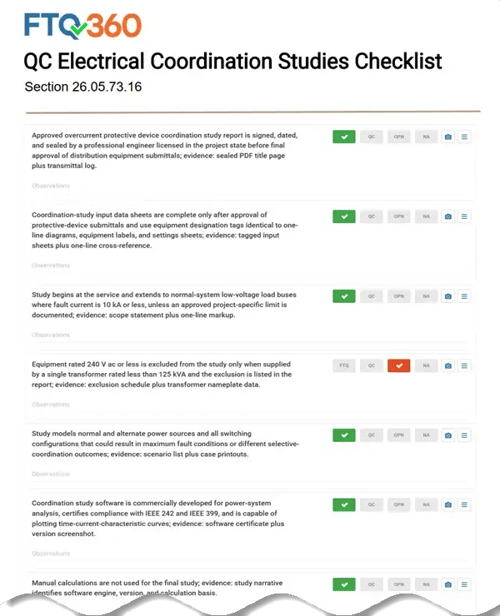
Checklist Preview

Common Failure Modes & Risk Prevention
This spec section has recurring field issues. Coordination work has a history of commonly encountered problems because the study often depends on exact device data, exact tags, and exact operating conditions that can shift during procurement and installation.
A study issued before exact submittals are approved can quickly lose value when the installed breaker, relay, or fuse differs from the modeled device. Tag mismatches between the one-line, the study, and field labels create another serious risk because the right setting can be applied to the wrong device.
Problems also surface when an alternate source, tie condition, or emergency operating mode is left out of the model, or when a series-rated combination is installed without matching the exact listed pair and installation condition.
Even after approval, undocumented setting changes, unresolved voltage sag impacts, or an incomplete closeout package can weaken the long-term usefulness of the study.
These risks are why the QAQC details that follow focus so heavily on controlled inputs, verified settings, and disciplined revision management.
Preparatory Phase
This phase takes place in the weeks before work begins.
Prepare for success by verifying that personnel, materials, equipment, and documentation are ready for work to begin. Before the model is built, you need approved protective-device submittals, the latest one-line diagrams, short-circuit inputs, and a clear responsibility matrix identifying the Power Systems Analysis Specialist, the Field Adjusting Agency, and startup or testing responsibilities.
You also need confirmation that the selected software is appropriate for power-system analysis and that utility source information, including service impedance and upstream device characteristics, is being captured before assumptions are locked.
This phase should also establish controlled record-document procedures so field tag changes, conductor lengths, catalog numbers, and settings revisions are entered promptly and consistently.
If approved submittals, utility data, qualifications, or one-line accuracy are still unresolved, this is where you hold the work and prevent weak study inputs from carrying into later phases.

Initial Phase
This phase confirms that work starts correctly. The first input package becomes the benchmark for everything that follows, so you need it to include the current one-line diagram, approved protective-device data, transformer characteristics, conductor information, motor and generator data, and utility source values before the study is accepted for review.
At the same time, the first field-survey sample should confirm that equipment tags in the study exactly match the tags on drawings, labels, and settings sheets.
Your first reviewed TCC package should show adequate time separation between upstream and downstream devices, address series-rated conditions where used, and confirm that transformer protection will ride through inrush and full-load current while still protecting the equipment.
The first settings sheets should already be practical enough to guide field application.
Follow-Up Phase
This phase aims to keep work proceeding correctly. As installation advances, you need routine checks to confirm that changes to conductor lengths, source data, device catalog numbers, switching arrangements, and operating modes are entered into the model before they affect energization decisions.
Curve review should continue across normal, alternate, tie, and emergency-source cases so the study still reflects the system you are actually putting into service.
At the field level, relay and breaker settings should be checked against the latest approved settings sheets, and testing records should confirm that adjustments were carried through correctly.
This is the phase that keeps production within limits by catching drift before it becomes a coordination failure.
Completion — Final Acceptance & Closeout
All of the work culminates with a final result; this phase ensures the completed installation meets project requirements. By closeout, the final coordination study report should be signed, dated, and sealed by the responsible professional engineer, and the final one-line should reflect actual installed sources, ties, transformer data, conductor sizes and lengths, motors, generators, and protective-device tags.
You should also confirm that the issued time-current curve set matches the settings actually applied in the field and that those settings are documented by device tag, date, and technician. Any recommendations, exceptions, or required equipment or setting changes identified by the study should be closed before turnover.
The final package should include the stamped study, final one-line diagram, study data files, list of protective-device settings, time-current coordination curves, and training records so the owner receives a usable operating record rather than a disconnected closeout bundle.
References and Other Specification Systems
References
Other Specification Systems
Equivalent sections should be verified before use in UFGS, VA Master Specifications, NMS, and RIB SpecLink. Related inherited controls also connect to 26.05.73.13, 26.23.00, 26.24.16, 26.27.26, and 26.28.16 where protective-device settings, SCCR, series ratings, and selective tripping interface with the coordination study.
FTQ360 Inspection & QAQC Platform
FTQ360 runs on tablets and phones (online or offline), so inspectors capture photos and measurements anywhere and sync later.
Required fields and conditional logic prevent skips and enforce holds. Time/user stamps and lot/location links keep the record auditable.
Dashboards surface patterns within a few pours, so you can adjust handling before defects propagate.
How to Use the Free Template (quick start)
Prefer the FTQ360 in-app setup?
Open Checklist Setup → Library, search for the code and tap to clone the checklist. Then tailor checkpoint template to your requirements.
If your team still needs paper in select areas, you can print the PDF from the FTQ360 app, mark it up in the field, then transcribe results and attach photos later—just note that paper won’t enforce required fields, conditional logic, or holds like the app does.
For implementation help, visit support.ftq360.com.
MasterSpec® and MasterFormat® are registered trademarks. This blog references section numbers and titles for clarity only and does not reproduce proprietary content. Copyright FTQ360.