

Purpose & Scope
Section 26.23.00 covers low-voltage switchgear used to distribute power through metal-enclosed assemblies built around buses, draw-out breakers, trip units, metering, interlocks, grounding, seismic anchorage, and acceptance testing.
The QAQC challenge is not just getting the gear set in place, but proving that ratings, alignment, protection, terminations, and operating features all match the approved design before you energize.
The checklist follows the three-phase control flow, Preparatory, Initial, and Follow-Up, so you can manage readiness, establish the first accepted installation, and then keep production within limits.
The FTQ360 version includes required photos, numeric measurements, test records, and sign-offs so the final record shows exactly what was verified, where, and when.
What the Checklist Covers
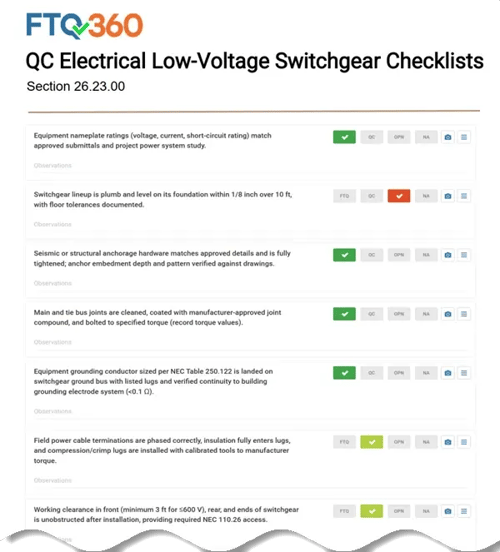
This low-voltage switchgear checklist follows the work from pre-installation coordination through final acceptance. You use it to confirm that submittals, one-line and three-line diagrams, breaker schedules, conduit-entry layouts, and factory test requirements are in place before delivery and setting begin.
It then moves into field controls such as room clearances, housekeeping pad levelness, receiving inspection of ratings and listing, bus construction, lug and cable-termination planning, and protection-setting coordination.
Once installation starts, the checklist tracks first-section leveling, anchorage, bus-joint assembly, breaker racking, control wiring, cable terminations, and maintenance-mode verification.
During production and closeout, it documents lineup assembly, device identification, trip-unit settings, CT/PT wiring, grounding, insulation resistance, primary current injection, functional testing, final labeling, and turnover records.
Checklist Preview

Common Failure Modes & Risk Prevention
This spec section has recurring field issues. Switchgear work has a long history of problems that usually start with fundamentals being missed early, then turning into operational or safety risks later. A lineup set on an out-of-level or noncompliant pad can bind breakers and stress bus alignment.
Bus joints assembled without the correct hardware, washer arrangement, or torque can overheat under load or fault. Wrong breaker frame sizes, interrupting ratings, or study settings can destroy coordination and leave the equipment mismatched to available fault current.
Mislanded CT secondary wiring, missing cable bracing in high-fault-current locations, or incomplete maintenance-mode and zone-selective-interlocking setup can create hidden hazards that do not show up until testing or an actual event.
Missing shutters, barriers, IR viewing windows, or closeout training packages usually point to a rushed turnover, not a completed installation. These are the priorities that drive the QAQC details in the phases that follow.
Preparatory Phase
This phase takes place in the weeks before work begins. Prepare for success by verifying that personnel, materials, equipment, and documentation are ready for work to begin.
Before the lineup ever lands on the pad, you need approved catalog data, shop drawings, one-line and three-line diagrams, nameplate and termination schedules, conduit-entry layouts, breaker features, settings coordination, and factory test requirements on site and aligned with the latest study.
This is also when you verify that the room can actually receive the gear, with documented front, rear, end, future-expansion, and top clearances, and that the housekeeping pad is complete, reinforced, and level within the required tolerances.
Receiving checks should confirm listing, ratings, enclosure type, bus construction, lug strategy, cable-bracing needs, and breaker protection features before any section is released for setting.
When clearances, pad levelness, anchorage details, nameplate ratings, settings, or cable-bracing requirements do not match the approved basis, this is where the hold point belongs so the same failures do not get built into the lineup.

Initial Phase
This phase confirms that work starts correctly. The first installed section becomes the benchmark for everything that follows, so you need to confirm plumbness, level, section-to-section alignment, approved anchorage, and proper embedment before the lineup extends.
The first accepted bus joint should show clean silver-plated contact surfaces, correct hardware, required washers, and recorded torque. The first breaker cell should demonstrate that racking, shutters, and interlocks work as intended with the door closed and without forced fit.
The first accepted control-wiring and cable-termination sample should also prove conductor type, termination method, identification, stress relief, and conduit details.
Before production continues, verify that maintenance mode and trip-unit functions operate correctly and that the accepted first article is fully logged. That early discipline prevents small installation errors from becoming repeated defects across the entire lineup.
Follow-Up Phase
This phase aims to keep work proceeding correctly. As additional shipping sections are assembled, you keep checking bolted joints, splice plates, bus alignment, enclosure bonding, breaker identification, interrupting ratings, and trip-unit settings against the approved drawings and study.
Routine inspections should also confirm conduit entry by the correct section, secure cable lacing and bracing where fault current demands it, proper CT/PT orientation and terminal-block treatment, and permanent labeling of control, metering, and communication wiring.
Just as important, you keep verifying that doors, shutters, barriers, mimic bus components, warning plates, and IR viewing windows are complete and functional.
When torque is undocumented, the wrong breaker is in a cell, settings are unverified, wiring is unlabeled, or cables are unsupported, production needs to stop until the condition is corrected.
Completion — Final Acceptance & Closeout
All of the work culminates with a final result; this phase ensures the completed installation meets project requirements.
At closeout, you verify that final room clearances still exist after the full lineup is installed and that accessible bus joints, anchors, lugs, and bonding hardware have been retorqued with calibrated tools and recorded values.
You also confirm continuity across shipping-section bonds and grounding paths, then complete insulation-resistance testing of the main bus and cable terminations and primary current injection of the protective devices against the scheduled settings.
Functional testing should demonstrate breaker racking, shutters, padlocking, electrical close and trip functions, undervoltage release, maintenance mode, zone-selective interlocking, metering, communications, key interlocks, and automatic throw-over where provided.
Final labels, one-lines, floor markings, and arc-flash information need to match the latest accepted analysis, not an earlier revision.
The closeout package should bring together factory test certification, field-service certification, warranty, final settings, torque logs, megger and injection reports, training records, and spare-parts inventory so energization and turnover do not proceed with unresolved protection, grounding, clearance, or interlock deficiencies.
References and Other Specification Systems
References
NFPA 70 (current adopted edition)
Other Specification Systems
UFGS 26 23 00 Low-Voltage Switchgear; VA 26 23 00 Low-Voltage Switchgear;
NMS 26 23 00 equivalent to be verified;
RIB SpecLink 26 23 00 equivalent to be verified; related inherited controls from 26 05 19, 26 05 26, 26 05 29, 26 05 33, and 26 05 73 where switchgear interfaces with conductors, grounding, supports, raceways, and coordination studies.
FTQ360 Inspection & QAQC Platform
FTQ360 runs on tablets and phones (online or offline), so inspectors capture photos and measurements anywhere and sync later.
Required fields and conditional logic prevent skips and enforce holds. Time/user stamps and lot/location links keep the record auditable.
Dashboards surface patterns within a few pours, so you can adjust handling before defects propagate.
How to Use the Free Template (quick start)
Prefer the FTQ360 in-app setup?
Open Checklist Setup → Library, search for the code and tap to clone the checklist. Then tailor checkpoint template to your requirements.
If your team still needs paper in select areas, you can print the PDF from the FTQ360 app, mark it up in the field, then transcribe results and attach photos later—just note that paper won’t enforce required fields, conditional logic, or holds like the app does.
For implementation help, visit support.ftq360.com.
MasterSpec® and MasterFormat® are registered trademarks. This blog references section numbers and titles for clarity only and does not reproduce proprietary content. Copyright FTQ360.