

Purpose & Scope
Section 26.28.16 covers enclosed switches and circuit breakers used to isolate, protect, and safely operate electrical distribution equipment in the field.
The scope includes enclosed switches, molded-case circuit breakers, overcurrent protection, environmental ratings, interlocks, labeling, and required testing tied to reliable facility performance.
The checklist follows the three-phase control flow, Preparatory, Initial, and Follow-Up, to keep installation and startup aligned with the approved design before final acceptance.
The FTQ360 version includes required photos, numeric measurements, and sign-offs so you can document compliance, corrective actions, and turnover readiness in one auditable record.
What the Checklist Covers
This enclosed switches and circuit breakers checklist tracks the work from pre-installation planning through final testing and closeout.
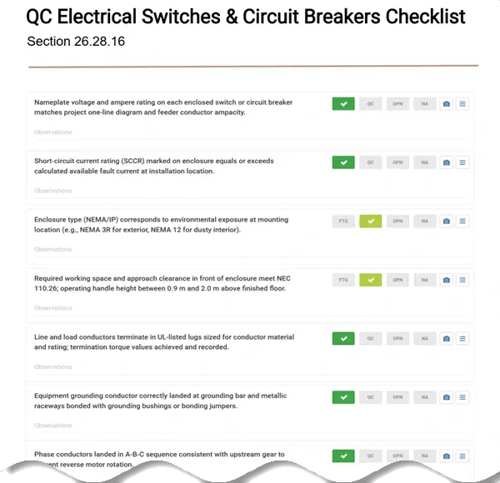
You use it to confirm approved product data, shop drawings, wiring diagrams, coordination information, and accessory schedules before fabrication and delivery move forward. It also helps you verify that each enclosure matches the approved voltage, ampere rating, short-circuit current rating, enclosure type, and accessory configuration before installation begins.
Once field work starts, the checklist follows mounting, clearances, grounding and bonding, conductor terminations, torque records, interlock operation, labeling, protective-device settings, and accessory wiring.
By closeout, it ties together insulation-resistance results, continuity checks, functional tests, warranty information, and final documentation for turnover.
Checklist Preview

Common Failure Modes & Risk Prevention
This spec section has recurring field issues. It has a history of commonly encountered problems that usually begin with equipment selection, installation discipline, or incomplete verification before energization.
An underrated SCCR or the wrong enclosure type can leave the equipment exposed to fault duty or environmental conditions it was never meant to handle, creating serious safety and reliability risks.
Untorqued terminations, double-lugging, damaged gaskets, open knockouts, and debris left inside the enclosure can turn an otherwise compliant installation into an overheating, moisture-ingress, or flashover problem.
Neutral-to-ground errors, misapplied fuse classes, or unapproved breaker settings can also undermine fault clearing, coordination, and safe operation. Door interlock or handle failures add another layer of risk because they affect both isolation and access to live parts.
These priorities drive the QAQC details that follow.
Preparatory Phase
This phase takes place in the weeks before work begins. Prepare for success by verifying that personnel, materials, equipment, and documentation are ready for work to begin.
Before installation is released, confirm that approved product data, shop drawings, wiring diagrams, time-current coordination curves, NRTL series-rating evidence where applicable, and accessory schedules are on site and coordinated.
Review the receiving plan so each enclosed switch or circuit breaker can be checked against approved voltage, ampere rating, SCCR, enclosure type, interrupting rating, and accessory requirements.
Confirm the outage and temporary-power plan, required notice for service interruption, working-space compliance, operating-handle height, environmental rating, grounding and bonding details, and protective-device settings before any equipment is mounted.
Missing outage approval, mismatched SCCR, incorrect enclosure type, or unapproved trip settings should hold the work.

Initial Phase
This phase confirms that work starts correctly. The first installed assembly should establish the standard for every enclosure that follows.
Verify that the first enclosure type matches the actual exposure at its location and that the first mounting sample is plumb, rigid, accessible, and installed with the required working space maintained.
Check the first line and load terminations in listed lugs, confirm torque is applied with a calibrated tool and logged, and verify grounding and neutral terminations are arranged correctly for the equipment application.
Then prove the first door interlock, operating handle, shunt trip, undervoltage trip, auxiliary contacts, alarm switch, and other scheduled accessories function and match the approved wiring diagram.
Confirm identification, source designation, and safety labels are in place before the area is released.
Follow-Up Phase
This phase aims to keep work proceeding correctly. During production, continue verifying nameplate voltage and ampere ratings, SCCR, enclosure integrity, and environmental suitability at each installed location.
Confirm conductor terminations remain compliant, phase sequence stays consistent with upstream gear, parallel conductors use listed terminations, and adjustable protective settings match the approved coordination values.
Keep watch on accessory wiring, gasket condition, unused openings, cleanliness inside the enclosure, and completion of torque and inspection records.
When the work drifts toward the wrong protective device type, missing interlock hardware, open knockouts, damaged seals, or undocumented settings, correct it before covers are closed or equipment is energized.
Completion — Final Acceptance & Closeout
All of the work culminates with a final result; this phase ensures the completed installation meets project requirements.
At closeout, verify that working space remains compliant in front of each enclosure, operating handles remain within the required height range, and access is clear for safe operation and maintenance. Confirm all accessible line, load, neutral, and grounding terminations have complete torque records tied to calibrated tools.
Review insulation-resistance testing, grounding continuity results, and functional operation of handles, door interlocks, shunt trip devices, undervoltage release, alarm switches, auxiliary contacts, ground-fault features, and electrical operators where provided.
Final labels should be complete, legible, and aligned with the latest identification and arc-flash information. The turnover package should include approved submittals, settings records, torque logs, test reports, outage approvals, warranty data, spare materials, and testing-agency certification where specified.
If SCCR, grounding, settings, labeling, or interlock deficiencies remain open, turnover should not proceed.
References and Other Specification Systems
References
NFPA 70 (current adopted edition)
Other Specification Systems
UFGS 26 28 16 Enclosed Switches and Circuit Breakers
VA 26 28 16 Enclosed Switches and Circuit Breakers
NMS 26 28 16 equivalent to be verified
RIB SpecLink 26 28 16 equivalent to be verified
Related inherited controls from 26 05 26, 26 05 29, 26 05 33, and 26 05 73 where enclosed switches and circuit breakers interface with grounding, supports, raceways, and coordination studies.
FTQ360 Inspection & QAQC Platform
FTQ360 runs on tablets and phones (online or offline), so inspectors capture photos and measurements anywhere and sync later.
Required fields and conditional logic prevent skips and enforce holds. Time/user stamps and lot/location links keep the record auditable.
Dashboards surface patterns within a few pours, so you can adjust handling before defects propagate.
How to Use the Free Template (quick start)
Prefer the FTQ360 in-app setup?
Open Checklist Setup → Library, search for the code and tap to clone the checklist. Then tailor checkpoint template to your requirements.
If your team still needs paper in select areas, you can print the PDF from the FTQ360 app, mark it up in the field, then transcribe results and attach photos later—just note that paper won’t enforce required fields, conditional logic, or holds like the app does.
For implementation help, visit support.ftq360.com.
MasterSpec® and MasterFormat® are registered trademarks. This blog references section numbers and titles for clarity only and does not reproduce proprietary content. Copyright FTQ360.