

Purpose & Scope
Section 26.05.26 covers the grounding and bonding work that makes an electrical system safe, stable, and testable over the life of the facility. In practice, that means much more than driving a few rods and landing a few green wires.
This section reaches across grounding electrodes, grounding electrode conductors, equipment grounding conductors, service bonding, separately derived systems, underground distribution components, bonding at piping and ducts, and any project-specific features such as test wells, ground rings, or lightning-protection interfaces.
The QAQC challenge is that many of these details are buried, enclosed, or otherwise difficult to verify once the work moves on. That is why grounding and bonding needs a disciplined inspection flow.
The checklist for this section follows the standard FTQ360 QAQC sequence of Preparatory, Initial, Follow-Up, and Completion. It is designed to confirm that materials match approved submittals, concealed connections are documented before cover-up, bonding paths remain continuous across interfaces, and final resistance and continuity testing proves the system performs as intended before energization.
When this process is handled well, grounding becomes a managed quality system rather than a last-minute code check.
What the Checklist Covers
This checklist starts well before the first conductor is installed. It covers submittal and coordination review for ground rods, conductors, connectors, busbars, exothermic materials, test wells, and special grounding applications.
It also establishes the grounding plan early, so the team identifies grounding electrodes, concrete-encased electrodes, building-steel bonds, service and separately derived system bonds, and telecommunications grounding features before excavation, concrete placement, or rough-in hides the work.
From there, the checklist moves into receiving, installation, and testing controls. It verifies that copper grounding conductors, listed connectors, rod dimensions, and grounding-bus components match approved documentation, while also screening out misapplied materials such as aluminum grounding conductors in contact with earth or concrete.
During installation, it tracks first-article acceptance for rods, below-grade connections, grounding buses, bonding jumpers, and test wells.
During production, it follows electrode interconnection, burial depth, rod spacing, bonding across raceways and flexible points, and source bonding at services and separately derived systems.
At closeout, it ties torque records, continuity checks, resistance testing, labeling, and as-built location records into one acceptance package.
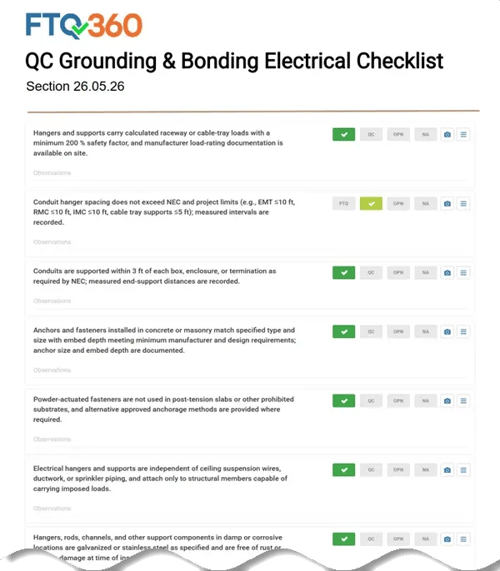
Checklist Preview

Common Failure Modes & Risk Prevention
Grounding and bonding failures are rarely dramatic while the work is still open. That is what makes them so risky.
One of the most common failures is incomplete interconnection of the grounding electrode system. A missed bond between building steel, metal water pipe, ground rods, or a concrete-encased electrode can leave the system with parallel fault paths, inconsistent reference potential, and a hidden deficiency that only shows up later during testing or operation.
Preventing that problem starts with a reviewed electrode map and strong pre-cover documentation.
Another recurring issue is the wrong connection method below grade. Where the project requires exothermic welds or listed irreversible compression connectors, a mechanical clamp or a poor weld can create a long-term corrosion point and a high-resistance path.
First-article approval matters here because buried grounding work does not get easier to fix after backfill. High ground resistance is another major cause of delay, usually tied to poor rod layout, inadequate spacing, or noncompliant test conditions. When the resistance test is delayed until the end without a plan, the result is often corrective work at exactly the point the team wants to energize.
Source bonding mistakes create another class of failure. Missing or undersized bonding jumpers at the service or at separately derived systems directly affect fault clearing and code compliance. Isolated grounding circuits can also be compromised in the field when the insulated grounding conductor is bonded incorrectly to raceway or the panelboard grounding bar.
Add in omitted bonding at water meters, gas piping, ducts, vibration-isolated equipment, or flexible connections, and the project can end up with a system that looks complete but does not provide a reliable, continuous grounding path.
The best prevention strategy is not more paperwork for its own sake. It is phased verification, location-based evidence, and clear hold points before concealment, startup, or energization.
Preparatory Phase
This phase takes place before installation starts, when the team still has the best chance to solve coordination problems cheaply. Begin by confirming that approved product data, installation instructions, coordination drawings, and the project grounding plan are all on site.
The plan should identify every grounding electrode, test well, ground ring, concrete-encased electrode, building-steel bond, service bond, separately derived system bond, and other grounding feature that must be coordinated with excavation, concrete work, or equipment rough-in.
Material review is equally important at this stage. The receiving process should confirm that the delivered copper grounding conductors, rod type and size, listed connectors, and busbar components match approved submittals.
This is also the point to reject aluminum grounding conductors that would be installed in contact with earth or concrete. Testing preparation belongs here too. The field team should define the fall-of-potential testing plan, identify test locations and project resistance thresholds, and verify that instruments are calibrated and ready.
Preparatory review should also focus on interfaces, because that is where grounding problems often hide. Water service, water meters, gas piping, air ducts, isolated grounds, vibration-isolated equipment, lightning-protection interfaces, and pad-mounted equipment all need to be resolved before the first crew starts work. The same is true for below-grade connection methods.
If buried grounding connections require exothermic welds or listed irreversible compression connectors, the method and corrosion-protection approach should already be established before anyone starts trench work.
A strong preparatory phase ends with a clear stop-work condition for missing grounding paths, uncoordinated test-well locations, or omitted bonding details discovered before burial, backfill, or concrete placement.

Initial Phase
The Initial Phase confirms that the first installation is right before it becomes the standard for the rest of the project. The first ground rod should be installed vertically, without damage, and set with the top 2 inches below finished floor or final grade unless the project detail requires something more stringent.
The first below-grade connection should demonstrate the required workmanship standard as well, whether that means a clean exothermic weld or a listed irreversible compression connection with full encapsulation and no visible voids.
This phase is also where the installation team proves the details that often become repetitive later. The first grounding bus installation should show the required copper bus, insulated spacers, and mounting clearances where busbars are indicated.
The first feeder or branch-circuit equipment grounding conductor should be routed with the circuit conductors, properly identified in green or green/yellow, and sized in accordance with NEC Table 250.122.
The first bonding jumper at a water meter, flexible piping section, or vibration-isolated piece of equipment should use listed connectors and maintain continuity without defeating the isolation the assembly is designed to provide.
Where test wells are required, the first assembly should demonstrate the full detail, including depth, cover, flush finish, and correct location at the grounding electrode electrically closest to the service.
No backfill, slab placement, or equipment setting should move forward until these first-article installations are accepted and logged. That early acceptance is what keeps a hidden grounding defect from multiplying across the project.
Follow-Up Phase
Once production work is underway, the Follow-Up Phase keeps the grounding system consistent as the project expands across rooms, trenches, pads, and equipment locations. One of the core checks here is electrode interconnection.
The field team should verify that building steel, metal water pipe, ground rods, concrete-encased electrodes, and other applicable electrodes are tied into one common grounding electrode system using the required conductor sizes. Underground grounding conductors should be checked for correct material, burial depth, and routing, and duct-bank grounding conductors should be verified where they are part of the design.
Rod spacing is another important control. Multi-rod grounding electrode systems only perform as intended when the rods are laid out correctly, including spacing at least one rod length apart and separation from other grounding electrodes as required.
At services and separately derived systems, inspections should confirm that the main bonding jumper or system bonding jumper is present at the correct source enclosure and sized correctly. Along the same path, the team should verify bonds across metallic raceways, cable trays, wireways, fences, piping, ducts, and flexible or expansion points, with listed jumpers installed where continuity would otherwise be interrupted.
The Follow-Up Phase also matters for the details that are easy to overlook during fast-paced rough-in. Manhole, handhole, and pad-mounted equipment grounding should be checked before cover-up, including rods, rings, sleeves, wraps, grout, and component bonds where applicable.
Grounding conductors should follow the shortest and straightest practical route, remain protected from physical damage where required, and avoid unapproved splices or poorly executed bends.
This is where digital QAQC becomes more than going paperless. A good field record ties each buried connection, trench photo, continuity check, and hold-point release to a location and installation phase, so the team can prove what was installed before the work disappears.
Completion — Final Acceptance & Closeout
Completion is where the project proves that grounding and bonding is not just installed but actually performing.
Before permanent electrical circuits are energized, the completed system should be inspected for physical and mechanical condition, and accessible bolted connections should be torque-verified with a calibrated wrench in accordance with manufacturer instructions.
Ground resistance testing should then be performed by the fall-of-potential method in accordance with IEEE 81, using compliant site conditions rather than artificially improved testing conditions.
Acceptance depends on measured results and on the quality of the record. Required resistance values should be checked against the project thresholds for the applicable system, and continuity testing should confirm an unbroken equipment-grounding path from the farthest inspected equipment grounding terminal back to the source panel or grounding bus.
If resistance values are too high, corrective work and retesting must be completed before the installation is accepted.
Closeout should also include dimensioned as-built drawings that locate test wells, ground rods, ground-ring segments, and separately derived system grounding points, with rod depth, rod quantity, and test references keyed to each location.
Accessible grounding electrode conductors and main bonding jumpers should be labeled “GROUND – DO NOT REMOVE,” and any grounding features that require periodic attention should be included in the operation and maintenance record with testing guidance based on the project requirements.
This final package is what turns hidden infrastructure into a traceable, defensible quality record.
References and Other Specification Systems
References
NFPA 70 (current adopted edition)
Other Specification Systems
UFGS 26 05 26 Grounding and Bonding for Electrical Systems
VA 26 05 26 Grounding and Bonding for Electrical Systems
NMS 26 05 26 equivalent to be verified
RIB SpecLink 26 05 26 equivalent to be verified
Related inherited controls from 26.05.19, 26.05.29, 26.05.33, and 26.23.00 where grounding interfaces with conductors, supports, raceways, and switchgear.
FTQ360 Inspection & QAQC Platform
FTQ360 helps teams run this section as a controlled field process instead of a stack of disconnected check sheets.
Grounding and bonding work often disappears behind walls, slabs, backfill, pads, and equipment lineups, so the inspection record has to be built while the work is still visible.
A digital workflow makes that practical by tying checkpoints, photos, test data, location tags, corrective actions, and closeout records to the same inspection path.
That gives project teams a cleaner way to manage buried work, hold points, and final acceptance without losing the field evidence needed later.
How to Use the Free Template (quick start)
Prefer the FTQ360 in-app setup?
Open Checklist Setup → Library, search for the code and tap to clone the checklist.
Then tailor checkpoint templates to your requirements.
If your team still needs paper in select areas, you can print the PDF from the FTQ360 app, mark it up in the field, then transcribe results and attach photos later, just note that paper won’t enforce required fields, conditional logic, or holds like the app does.
For step-by-step help, visit support.ftq360.com.
MasterSpec® and MasterFormat® are registered trademarks. This blog references section numbers and titles for clarity only and does not reproduce proprietary content. Copyright FTQ360.