

Purpose & Scope
Section 26.05.29 covers the support framework that keeps electrical systems secure, aligned, and ready to perform over the life of the facility. The scope includes steel, aluminum, and non metallic slotted support systems, conduit and cable support devices, supports for conductors in vertical conduit, fabricated structural supports, anchoring components, and metal support assemblies for equipment.
In practice, this section is where installation quality either protects the electrical work that follows or quietly introduces future failures through bad anchorage, poor spacing, wrong materials, and weak coordination overhead.
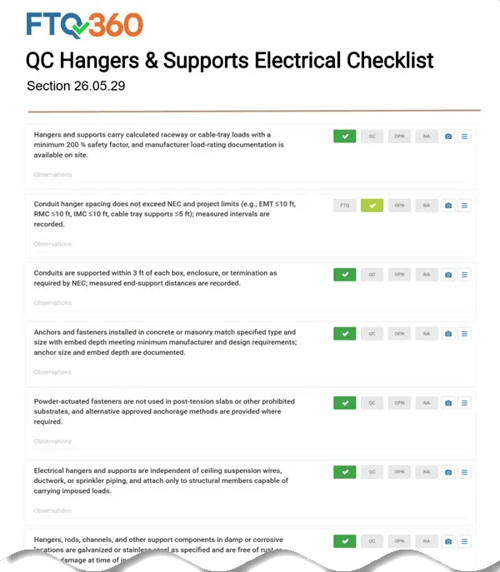
The FTQ360 checklist organizes that work into Preparatory, Initial, and Follow-Up controls so teams can verify attachment methods, document field conditions, and build an auditable record before ceilings close and access becomes limited.
What the Checklist Covers
This checklist is built to control the full support lifecycle, not just isolated hanger details. It starts with submittals, delegated-design calculations where required, manufacturer installation instructions, and coordination drawings that show structural attachment points and overhead conflicts before layout begins.
It then moves into first-article verification of trapezes, single-raceway supports, anchor installations, rod sizing, support spacing, channel cuts, weld repairs, and coating protection.
During production, the checklist tracks substrate-specific anchorage, spacing compliance, clearances from adjacent services, seismic restraint installation where required, cable-tray alignment, fabricated support quality, and concrete base readiness for supported equipment.
By closeout, it ties those inspections back to final walkdowns, coating-repair records, anchor documentation, welding certifications, seismic certificates, and turnover packages that prove the installation was supported correctly from start to finish.
Checklist Preview

Common Failure Modes & Risk Prevention
Most field problems in this section come from shortcuts that seem small until they affect an entire area. One of the most common is support attachment to nonstructural elements such as ceiling wires, ductwork, or sprinkler piping instead of the building structure.
That shortcut leads to sagging, movement, rejected inspections, and sometimes cascading coordination problems when other trades discover the conflict later. Another recurring issue is the wrong anchor for the substrate.
When crews mix expansion anchors, toggles, inserts, beam clamps, or powder-actuated fasteners without verifying the base material first, the result can be cracked substrate, poor embedment, pullout risk, or structural damage.
Spacing errors are just as costly. Supports installed too far apart or too far from boxes and terminations create deflection, strain at fittings, and straightforward noncompliance. Powder-actuated fasteners used in prohibited slabs create a different class of risk because the failure may not be visible until after damage is done.
Seismic work adds another layer: omitted or misoriented bracing can turn a routine support installation into a life-safety issue and stop downstream work.
Even where the support geometry is right, coating damage left unrepaired in damp, corrosive, exterior, or weather-exposed locations accelerates corrosion and reduces service life.
The checklist is designed to catch these failures early by forcing verification of structural attachment, anchor selection, spacing, seismic details, coating repairs, and equipment-base conditions before the work is concealed.
Preparatory Phase
This phase is where support quality is won or lost. Before installation starts, the team should have approved product data, shop drawings, delegated-design calculations where applicable, and manufacturer instructions for channels, hangers, anchors, inserts, clamps, and support assemblies.
Coordination drawings need to show structural members, ceiling modules, ductwork, piping, luminaires, sprinklers, access panels, and similar overhead conflicts so the support layout is based on the real field condition rather than assumptions.
Load review is equally important. Support design should confirm that the minimum static design load reflects the weight of supported components plus 200 pounds, and that multiple-raceway trapezes are sized for future capacity growth without exceeding design limits.
The preparatory phase also sets the rules for anchorage and durability. The anchorage plan should assign approved fasteners by substrate for wood, steel, masonry, new concrete, existing concrete, and hollow-wall conditions, while clearly identifying where powder-actuated fasteners are prohibited.
Material planning should distinguish where galvanized, stainless, or approved nonmetallic systems are required and where plain or painted steel is acceptable.
If fabricated supports or concrete equipment bases are part of the work, the team should also verify pad dimensions, anchor edge distances, mix requirements, welding procedures, and welder qualifications before field crews begin.
If structural attachment points, seismic details, or substrate-specific anchor approvals are unresolved, that is a legitimate stop-work condition before overhead installation starts.

Initial Phase
The initial phase proves that the first installed support is worth repeating. The first trapeze or single-raceway support should demonstrate attachment to structural members only, with no reliance on ceiling grid, ductwork, or sprinkler piping.
The first rod-supported assembly should confirm the specified rod size, including the minimum 1/4-inch hanger rod where applicable, and show correct thread extension beyond nuts. The first anchor installation in concrete or masonry should verify type, diameter, and embedment against the approved submittal and design requirements rather than field habit.
This is also the point where spacing and workmanship have to be measured, not assumed.
The first support sample should confirm required support intervals and end-support distances, including support within 3 feet of boxes and terminations where required. Slotted channel cuts should be square and burr-free, with proper fittings and end protection where needed to avoid cable damage.
If field welding or galvanizing repair is part of the assembly, the first repaired area should be accepted before production work continues.
That first-article review matters because it establishes the installation standard for every run that follows.
Follow-Up Phase
Once production starts, the checklist keeps the work inside the approved limits area by area.
Ongoing inspections should confirm that conduit, cable, and cable-tray supports stay within required spacing and remain properly supported near enclosures and terminations. Fasteners and anchors should be checked continuously by substrate so the installed hardware matches the approved use condition rather than whatever happens to be available in the gang box.
Overhead support work also needs to preserve coordination space, including minimum clearances from adjacent HVAC, plumbing, sprinkler, and other building services, while maintaining access to ceiling modules and equipment.
Material condition remains a live QAQC issue throughout installation. In corrosive, damp, exterior, or weather-exposed locations, the installed support components should match the required finish and keep coatings intact.
Where seismic criteria apply, bracing and sway restraints should appear at the right intervals, in the right orientation, and with the listed hardware shown on approved details. Cable-tray supports should stay level within the project limits, and fabricated metal supports should be cut, fit, aligned, welded, bolted, and repaired without leaving damaged galvanized or painted areas open to corrosion.
Concrete bases for supported equipment also need verification before equipment is set, including dimensions, anchor placement, and surface readiness.
Repeated anchor misuse, undersized supports, missing seismic hardware, or attachment to nonstructural elements are all reasons to stop the affected area and correct the installation before it spreads.
Completion — Final Acceptance & Closeout
Final acceptance is not just a visual check that the hangers are in place.
It should confirm that all raceway and cable supports meet approved spacing, end-support, and clearance requirements and remain attached only to structural elements capable of carrying the imposed loads. Installed anchors should match the approved type and embedment requirements, while concrete bases should keep anchors the required distance from edges and meet the specified dimensions and strength criteria before supported equipment is turned over.
Closeout should also verify the smaller details that often expose weak workmanship. Threaded rods should extend the required distance beyond nuts where specified, locknuts or double nuts should be installed correctly, cable-tray supports should finish level, seismic restraints should be complete where required, and all field welds, abraded painted areas, and galvanized repairs should be properly touched up and documented.
The turnover package should gather the full record in one place: shop drawings, delegated-design calculations, welding certificates, seismic qualification data, anchor records, coating logs, inspection reports, and final walkdown documentation.
If support anchorage, seismic restraints, coating repairs, or concrete-base deficiencies are still open, equipment set and final turnover should wait.
References and Other Specification Systems
References
NFPA 70 (current adopted edition)
ASTM F3125/F3125M Grade A325/A325M
Other Specification Systems
UFGS 26 05 29 Hangers and Supports for Electrical Systems
VA 26 05 29 Hangers and Supports for Electrical Systems
NMS 26 05 29 Hangers and Supports for Electrical Systems
RIB SpecLink 26 05 29 Hangers and Supports for Electrical Systems
FTQ360 Inspection & QAQC Platform
FTQ360 gives field teams a practical way to manage this section as a live quality process instead of a punch-list exercise after the fact.
Inspectors can capture photos, measurements, location-based evidence, and sign-offs from phones or tablets in the field, then sync once they have service again.
Required responses, conditional logic, and hold points help teams enforce anchor verification, spacing checks, coating repairs, and seismic review before unsupported or noncompliant work moves forward.
Because the record is time-stamped and organized by area, support type, and inspection result, recurring installation mistakes become visible early enough to correct before they affect large sections of the project.
How to Use the Free Template (quick start)
Prefer the FTQ360 in-app setup?
Open Checklist Setup → Library, search for 26.05.29, and clone the checklist into your project.
From there, tailor checkpoints, evidence requirements, and hold points to match the project specification, approved submittals, and field conditions.
Teams that still need paper in limited situations can print the PDF version, complete it in the field, and upload results later, but the digital workflow is what enforces required fields, conditional responses, and stop-work logic in real time.
For implementation help, visit support.ftq360.com.
MasterSpec® and MasterFormat® are registered trademarks. This blog references section numbers and titles for clarity only and does not reproduce proprietary content. Copyright FTQ360.