

Purpose & Scope
The HB.11.00 Incident and Injury Report checklist helps production homebuilders document jobsite incidents, injuries, near misses, equipment damage, utility strikes, immediate care actions, area stabilization, witness information, photo evidence, notifications, corrective actions, and follow-up review.
For a production builder, incident reporting is not just an administrative form after something goes wrong. It is a field-control process that protects people, stabilizes the affected area, documents facts while they are still fresh, assigns corrective actions, and determines whether similar hazards may exist on other active lots, plan types, crews, or communities. When reporting is late, incomplete, or treated as a generic safety note, the builder loses the ability to understand what happened, control repeat exposure, support recordkeeping, and confirm that work can resume safely.
The checklist gives the superintendent, safety lead, trade partner supervisor, and management team a structured way to record the incident, document initial care, protect evidence after rescue or stabilization, notify the required parties, evaluate recordability or reportability where applicable, close corrective actions with evidence, and release the affected area only after hazard control has been verified.
Checklist Preview
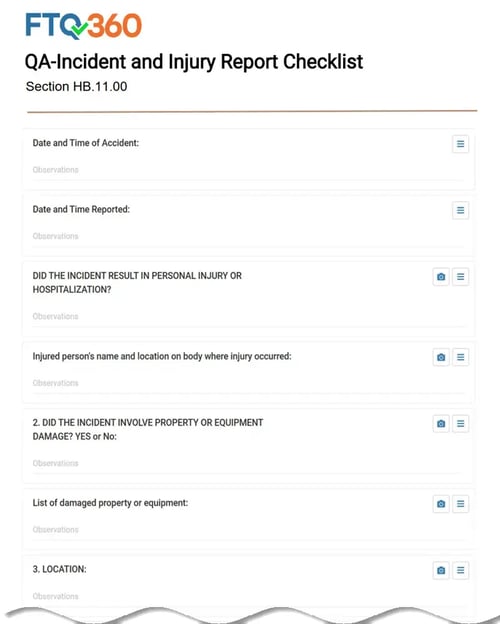

What the Checklist Covers
This checklist begins with the emergency and reporting information needed before active work starts. The site emergency plan, reporting contacts, nearest medical facility, lot address protocol, incident form access, emergency access route, muster or contact information, first-aid supplies, fire extinguisher, and communication method should be available and current. The inspection record should include photo or document evidence so the team can respond quickly if an incident occurs.
The checklist then confirms that trade partners understand the reporting expectations before work advances. Trade partner supervisors and crews should be briefed on immediate notification, evidence preservation, no-disturbance rules except for rescue or stabilization, and the notification chain for superintendent, safety, management, HR, insurance, claims, municipal, utility, or third-party contacts where required by incident type. Toolbox talk rosters and topic records help show that reporting expectations were communicated before the incident response is needed.
The physical incident record captures what happened and what was done first. Incident time, location, initial severity, injured person, trade partner, witness list, initial care action, responder name, condition of the area, equipment or materials involved, weather or lighting conditions, access conditions, and hazard condition are recorded. Photos or video should capture the affected area without disturbing evidence except for rescue or stabilization.
The checklist also separates immediate hazard control from root-cause prevention. Securing the area, barricading, tagout, emergency response, first aid, or removal from exposure are immediate controls. Corrective actions that prevent recurrence are assigned separately with responsible party, due date, evidence requirement, and reinspection status. This prevents the incident from being closed with a vague instruction to “be careful” instead of a verified corrective action.
The checklist closes with follow-up and release conditions. The final incident report should include facts, care status as appropriate, witness information, photos, notifications, recordability or reportability determination, corrective actions, reviewer notes, closure evidence, and management review. Work in the affected area should not resume normally until the designated reviewer, safety lead, superintendent, or competent person has verified hazard control and released the area.
Why This Stage Matters for Production Builders
Incident and injury reporting matters because production builders operate many active lots, repeated scopes, repeated trade partners, and recurring work methods at the same time. A ladder issue, excavation hazard, utility strike, electrical exposure, scaffold condition, access-route problem, equipment failure, or hot-work concern on one lot may not be isolated. If the same condition exists on other active lots, the risk can repeat before management sees the pattern.
The production risk is not only the incident itself. It is the failure to report the incident promptly, preserve the facts, assign corrective action, notify the right parties, and check whether similar hazards exist elsewhere. When the record is weak, the builder may not know who was involved, what changed at the scene, whether witnesses were identified, whether medical care was documented, whether reporting requirements were reviewed, whether the trade partner corrected the hazard, or whether work resumed before the area was safe.
HB.11.00 should therefore be treated as a stage-release control for safe work resumption. The affected area should not return to normal production simply because the immediate disruption has passed. It should return to normal work only when the incident is reported, the area is stabilized, evidence is captured, required notifications are made, corrective actions are assigned and verified, repeat-risk review is completed where needed, and the responsible reviewer confirms that work may resume.
Common Failure Modes & Risk Prevention
Late or incomplete incident reporting usually begins with an unclear notification chain, uncertainty about who owns the report, or reluctance to slow down production. The consequence is weak recordkeeping, claims exposure, and uncontrolled hazard conditions. Prevention depends on same-day reporting with time-stamped entries, clear superintendent or safety-contact notification, lot and location identification, injured person and trade partner information, initial severity, and initial care action.
Area release before hazard correction is another high-risk failure. Schedule recovery pressure can push the affected area back into normal work before the actual hazard has been controlled. The consequence can be a repeat injury, near miss, or larger incident. Prevention depends on keeping the no-advance condition open until a designated competent person, safety lead, superintendent, or authorized reviewer verifies the area, documents the release, and confirms that work may resume.
Missing witness and photo evidence often happens when cleanup begins before documentation. The consequence is disputed facts, weaker root-cause review, and poor corrective action. Prevention depends on an evidence-first response after rescue or stabilization. Witness statements should be collected from available personnel before conditions change. Photos or video should capture the incident area, equipment, material, access condition, weather or lighting, and hazard condition without disturbing evidence beyond what is needed for rescue or stabilization.
Generic corrective actions are a recurring problem. “Be careful,” “remind crew,” or “watch footing” may describe concern, but they do not create a verifiable control. The consequence is repeated hazards across lots or crews. Prevention depends on assigning each corrective action to a specific responsible party with a due date, evidence requirement, and reinspection status. Closure should not rely on trade self-report alone when superintendent, safety lead, or management verification is required.
Failure to review related lots can allow the same hazard to repeat elsewhere in the community. If an incident involves equipment, access, scaffold, ladder, excavation, electrical source, hot work, utility strike, or other repeating condition, comparable lots and active crews should be reviewed before normal production continues. The related lot review should identify the lots checked, conditions found, corrective actions assigned, and whether the issue is isolated or part of a broader production pattern.
Before Work Advances
Before active work advances, the builder needs the incident-response structure in place. The site emergency plan, reporting contacts, nearest medical facility, lot address protocol, incident form access, emergency access route, muster or contact information, and communication method should be verified and current. If emergency access is blocked, lot address visibility is poor, contact information is outdated, or incident form access is unclear, the site is not ready for a disciplined incident response.
First-aid supplies, fire extinguisher access, emergency communication, and required site response materials should also be available at active work areas. The checklist should capture evidence that the field team can respond before a problem occurs, not only after an incident has already exposed a gap.
Trade partners should be briefed on incident reporting expectations. The briefing should cover immediate notification, no-disturbance rules except for rescue or stabilization, witness identification, photo documentation, affected-area control, and the escalation matrix. Toolbox talk rosters should be attached so the builder can confirm that crews received the expectations before work proceeded.
The responsible reviewer for recordkeeping, internal management notification, safety review, HR, insurance, or claims coordination should be identified before the stage begins. The checklist should log the role assignment so the incident record does not stall because no one knows who should review recordability, reportability, corrective action closure, or management escalation.
Job-Ready Verification
Job-ready verification confirms that prerequisite information and response conditions are acceptable before the current stage proceeds. For HB.11.00, this means the builder verifies that the first reported incident or near miss is entered promptly, documented completely, and controlled before normal work resumes in the affected area.
The first reported incident should be entered on the same day with time, location, severity, injured person or affected party, trade partner, witness list, and initial care action complete. The record should identify who was notified, when they were notified, how they were notified, and what immediate response was taken. If the report is opened late or missing key facts, the builder should correct the reporting process before the same weakness repeats on other lots or crews.
The incident area should be photographed and stabilized before normal work resumes. Rescue and immediate hazard stabilization come first, but evidence should be captured before cleanup or normal work changes the scene. The affected-area no-advance condition should remain open until the designated reviewer confirms that the hazard has been controlled and the area is released.
Initial corrective action should distinguish immediate hazard control from root-cause prevention. Barricading, tagout, removal from service, temporary access control, or first aid may address immediate exposure. Root-cause prevention may require a revised method, replacement control, schedule or sequencing change, equipment inspection, additional crew briefing, or related lot review. Both types of action should be assigned with responsible party, due date, and evidence requirement.
If the incident, injury, near miss, equipment damage, utility strike, or unsafe condition could repeat, the same-condition review should begin on active lots before work continues under the same method. The goal is to prevent one lot’s incident from becoming a repeated production hazard.
Progress Preview
During incident follow-up, progress preview checks help the builder keep the record accurate as facts change. These checks are useful because medical status, witness statements, photos, corrective actions, reviewer notes, and notifications may develop over time, but they do not authorize normal work by themselves. They support the final release decision.
The incident record should be updated as facts change, with time-stamped entries. Medical or care status should be documented appropriately. Witness statements should be attached with names, contact information, and statement times. Photos and video should remain tied to the specific lot, location, equipment, material, and hazard condition. Reviewer notes should show what was evaluated and what remains open.
Corrective actions should be tracked to closure by responsible party, not by general site status. Each corrective action should require photo, document, inspection, or signoff evidence. A trade partner’s statement that a correction was completed should not close the item unless the required verification evidence is attached and reviewed.
The affected equipment, access route, temporary control, scaffold, ladder, excavation, electrical source, hot-work condition, or other incident-related condition should be verified before release. Equipment or tools involved in the incident should be tagged out and removed from service until inspected by a competent person or other designated reviewer. Tag photos and release records should be attached.
Progress preview also monitors recurrence. Related lots, crews, and trade partner performance should be checked when the condition could exist elsewhere. Repeated incident categories should trigger builder-level review and additional lot audits. If schedule recovery pressure contributed to the hazard, the corrective action should address the schedule or sequencing issue rather than only the field symptom.
Stage Release & Safe Work Resumption Readiness
Stage release is the governing inspection event for HB.11.00. The affected area is ready for normal work to resume only when the incident report is complete, immediate hazard controls are verified, corrective actions are assigned or closed as required, notifications are documented, required reviews are complete, and the designated reviewer releases the area.
The final incident report should include the incident facts, injury or care status as appropriate, witness information, photos or video, notification history, reviewer notes, corrective actions, closure evidence, and management review. The record should distinguish what happened, what was done immediately, what was done to prevent recurrence, who reviewed the condition, and whether work may resume.
Recordability or reportability review should be documented against OSHA, state, local, builder, insurance, claims, or other applicable requirements. OSHA, state, or local reportable events should be escalated and documented per required timeframes. Confirmation, reviewer, and submission evidence should be retained where applicable. Internal builder review should not be treated as a substitute for required external reporting where external reporting applies.
Corrective actions should be verified before normal work resumes in the affected area. The superintendent, safety lead, competent person, or designated reviewer should verify hazard control, equipment tagout or release when applicable, barricades, replacement controls, or revised work methods before closing the condition. No closure should rely only on unverified trade self-report when the item affects work resumption.
Lessons learned should be communicated to affected crews and similar active lots where the same hazard could repeat. The record should attach a roster, revised control, updated checklist, or related lot review evidence. Trade partner supervisors should confirm that affected crews have been briefed on the corrective action before returning to work.
If a checkpoint fails, the record should identify the location, failed condition, responsible trade partner or reviewer, correction scope, evidence requirement, and reinspection result. Incomplete reporting, missing witness or photo evidence, unverified hazard control, missing notification, unclear recordability or reportability review, open corrective action, or unresolved repeat-risk review should prevent normal work from resuming in the affected area until resolved.
For production builders, the completed release record becomes trend data. When incidents and near misses are tracked by community, lot, plan type, trade partner, crew, task, hazard category, severity, recurrence, corrective action, days open, and work-resumption status, the builder can see whether an incident is isolated or part of a larger pattern. That visibility helps prevent one safety event from becoming a repeated production risk across the next release group.
References and Related Specification Systems
References
Primary reference inputs for this checklist include OSHA 29 CFR Part 1904 for recording and reporting occupational injuries and illnesses, OSHA 29 CFR 1904.29 for OSHA 300, 300A, and 301 or equivalent recordkeeping forms where applicable, OSHA 29 CFR 1904.39 for reporting fatalities, hospitalizations, amputations, and loss of an eye to OSHA where applicable, and OSHA 29 CFR 1926 Subpart C for general safety and health provisions including recording and reporting, first aid, fire protection, housekeeping, sanitation, and PPE provisions.
Builder site emergency plans, incident escalation matrices, trade partner safety requirements, state or local worker injury reporting requirements, utility notification requirements where applicable, insurance and claims procedures, HR documentation protocols, and municipal or third-party notification requirements should be verified against the actual incident type and project location before being treated as controlling.
Related Specification Systems
Related specification systems may include construction safety, accident prevention, jobsite health and safety, incident reporting, emergency response, first aid, temporary controls, utility strike response, equipment tagout, and project reporting requirements. UFGS, VA Master, NMS, and RIB SpecLink equivalents should be verified against actual project safety, accident prevention, and incident reporting requirements. The Homebuilder checklist does not assume a direct construction-spec section equivalent. Applicability should always be confirmed against the builder’s standards, jurisdiction, trade partner agreements, and incident-specific requirements.
FTQ360 Inspection & QAQC Platform
FTQ360 helps production builders manage incident and injury reports as structured safety, documentation, and safe-work-resumption records. Field teams can open the HB.11.00 checklist on phones or tablets, document the lot and location, attach time-stamped photos, record witness information, identify the responsible trade partner, document initial care, assign corrective actions, track reviewer notes, attach notification records, and capture superintendent, safety lead, or management signoff before the affected area returns to normal work.
Required fields, photo evidence, witness records, correction assignments, reinspection status, reviewer signoff, and release status help prevent incident closure from depending on memory, verbal updates, or general site status. Time stamps and user stamps show who reported, reviewed, corrected, and released the condition. Community, lot, plan type, trade partner, crew, task, incident category, severity, recurrence flag, corrective action, days open, and release status make recurring incident risks easier to see before they spread across the production cadence.
For homebuilders, the value is not simply replacing a paper incident form. The value is knowing which incidents were reported, which areas remain restricted, which corrective actions are open, which trade partners own the correction, which notifications are documented, which lots require related review, and where recurring safety risk is emerging before it affects people, schedule, claims, warranty exposure, or homeowner confidence.
How to Use the Free Template
For the fastest digital setup, open FTQ360 Checklist Setup, go to the Library, search for HB.11.00 Incident and Injury Report, and clone the checklist.
Then tailor the checkpoint templates to your builder emergency plan, reporting contacts, escalation matrix, trade partner safety requirements, HR and insurance workflow, state or local reporting requirements, OSHA review process, utility notification process, required photo documentation, corrective-action workflow, and safe-work-resumption release rules.
If your team still uses paper in selected areas, the checklist can also support field markup and later transcription. Paper can capture notes, but it cannot enforce required fields, time-stamped photo evidence, witness information, correction ownership, notification records, reinspection status, reviewer signoff, affected-area release status, or recurring-incident visibility the way a digital QAQC workflow can.
For step-by-step help, visit support.ftq360.com.
FTQ360 inspection and QAQC software helps homebuilders document incidents promptly, verify hazard control, make disciplined safe-work-resumption decisions, prevent repeated incident conditions, strengthen trade partner accountability, and protect production continuity through consistent field evidence.
MasterSpec® and MasterFormat® are registered trademarks. This blog references related specification systems for clarity only and does not reproduce proprietary content. Copyright FTQ360.