

Purpose & Scope
Section 03.41.00 covers plant-fabricated precast concrete members, including beams, columns, double tees, wall panels, and structural slabs, and the field erection, shoring, connection hardware, alignment, grouting, and bearing requirements that ensure structural performance.Because precast combines factory precision with field fit-up, the earliest deviations in camber, bearing surface preparation, lifting, or bracing can cascade into alignment issues across entire elevations.
The three-phase QAQC flow, Preparatory, Initial, and Follow-Up, keeps these risks controlled by confirming readiness before the first pick, validating alignment and bearing at first placement, and ensuring consistency across all subsequent sets.
FTQ360 records camber readings, bearing conditions, connection hardware engagement, and panel alignment so you maintain a complete, traceable record of erection quality.
What the Checklist Covers
You use this checklist from initial delivery and staging through erection, grouting, and final alignment.
Preparatory steps confirm approved shop drawings, lifting plans, rigging inspections, connection hardware, bearing pad specifications, grout types, and sequencing, controls that directly relate to root causes of alignment drift and bearing failure.
During the Initial phase, inspectors verify the first piece’s alignment, camber match, bearing pad seating, bolt-hole fit-up, shim stacks, temporary bracing, and lifting technique.
Follow-Up inspections monitor consistency across repeated picks, grouting beneath bearing plates, brace tension, joint width, and cumulative alignment as elevations rise.
At completion, inspectors verify final grouting, hardware torque, joint uniformity, and surface repairs, producing a complete QAQC package tied to each piece mark.
Checklist Preview
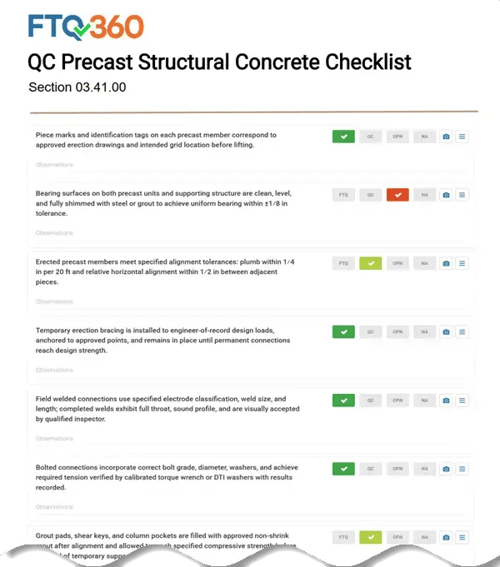
Click to Download Full Checklist

Common Failure Modes & Risk Prevention
Precast structural concrete has recurring field issues because factory tolerances, transport effects, and erection sequencing all converge during fit-up.
Most failures originate in the Preparatory and Initial phases, where bearing preparation, lifting configuration, camber comparisons, and hardware verification determine how well pieces align in the field.
The failure modes below show how each risk connects directly to FTQ360 checkpoints in all three phases.
Bearing pad misalignment or uneven support
Root cause: Shims shifting during placement, uneven grout bed, incorrect pad thickness, or debris left on the bearing shelf.
Field indicators: Panel rotation, rocking, diagonal cracking at supports, joint mismatch, or excessive load transfer to a single pad.
FTQ360 Inspection: Preparatory-phase entries document bearing pad specification and cleanliness; Initial-phase photos capture pad placement and shim stacks; Follow-Up records confirm uniform support and flag repeated bearing discrepancies across piece marks.
Camber mismatch leading to cumulative misalignment
Root cause: Plant production variability, moisture content differences, transport effects, or storing pieces out of sequence.
Field indicators: Step-offs between adjacent members, joint height differences, slope irregularities in tees or girders.
FTQ360 Inspection: Preparatory-phase camber data is logged for each piece; Initial-phase alignment checks compare the first picks; Follow-Up logs track panel-to-panel transitions so trends emerge early, preventing tolerance drift up the elevation.
Connection hardware misfit or improper engagement
Root cause: Bolt-hole drift, weld distortion, misaligned inserts, or hardware installed at the wrong location or orientation.
Field indicators: Forced fit-up, misaligned plates, bolts not seating, persistent panel movement under wind or crane adjustment.
FTQ360 Inspection: Preparatory-phase checks verify connection hardware; Initial-phase photos confirm proper engagement and seating; Follow-Up torque logs and alignment checks reveal repeated hardware issues tied to specific crews, lifts, or piece types.
Movement or damage during lifting and handling
Root cause: Incorrect rigging angles, unbalanced picks, impact during transport, or improper storage orientation.
Field indicators: Corner spalls, cracked edges, strained hardware, or hairline cracks radiating from lifting points.
FTQ360 Inspection: Preparatory-phase rigging-plan verification; Initial-phase lift photos document sling angles and pick points; Follow-Up inspection logs track repeated handling damage patterns across similar members.
Improper bracing and instability during erection
Root cause: Missing or under-tensioned braces, unapproved substitutions, or bracing not installed in the required sequence.
Field indicators: Panel drift, joint widening, plumbness deviations, or movement under wind loads.
FTQ360 Inspection: Preparatory-phase brace-layout verification; Initial-phase plumbness and brace-tension checks; Follow-Up logs monitor brace condition until permanent connections are complete.

Preparatory Phase
Prepare for success by verifying that personnel, equipment, materials, and documentation are ready for work to begin. Inspectors confirm approved shop drawings, lifting plans, rigging inspections, bearing pad specifications, anchor hardware, connection details, and grouting materials.
These controls directly address the root causes of bearing pad misalignment, camber mismatch, and hardware drift. Staging areas are checked, piece marks are verified against erection sequencing, and environmental constraints such as wind limits are reviewed.
FTQ360 captures bearing surface photos, rigging configurations, and lift plans so the Initial phase begins with known, well-documented conditions.
Initial Phase
This phase confirms that work starts correctly. Inspectors verify the first pick’s camber, bearing seating, shim stack arrangement, plumbness, alignment, and hardware engagement.
These checks directly counteract the failure modes linked to misalignment, forced fit-up, and bearing rotation. Photos record lift angles, brace installation, and connection fit.
Any deviations, such as pad displacement, bolt mismatch, or insert misalignment, are corrected immediately so all subsequent erections follow a validated standard.
Follow-Up Phase
This phase aims to keep work proceeding correctly. Inspectors monitor consistency across picks, confirm brace tension, track joint widths, verify uniform bearing support, and check for handling damage on each piece.
These checks connect directly to the indicators identified in the failure modes, step-offs, rocking, forced connections, or cracked corners.
FTQ360’s location-linked logs highlight trends across piece marks, panels, or elevations, enabling the team to detect early alignment drift and correct it before stacking continues.
Completion, Final Acceptance & Closeout
All of the work culminates with a final result; this phase ensures the completed installation meets project requirements. Inspectors verify grouting beneath bearings, torque hardware, plumbness, joint uniformity, and final alignment.
Any patching or surface repairs are documented and tied to individual piece marks. The complete FTQ360 record, bearing pad photos, camber comparisons, alignment checks, rigging logs, and connection verification, forms a defensible acceptance package for turnover, warranty, and future maintenance.
References and Other Specification Systems
References
ACI 318 – Building Code Requirements for Structural Concrete.
Other Specification Systems
UFGS 03 41 00 Precast Structural Concrete
FTQ360 Inspection & QAQC Platform
FTQ360 runs on tablets and phones (online or offline), allowing inspectors to capture photos and measurements at the point of work.
Required fields and conditional logic prevent skips and enforce holds. Time and user stamps maintain traceability, and lot/location tracking ties each reinforcement inspection to the pour or structural element.
Dashboards reveal patterns, such as recurring low cover or splice drift, so teams can correct issues before they propagate across floors or shear walls.
How to Use the Free Template (quick start)
Prefer the FTQ360 in-app setup?
Open Checklist Setup → Library, search for the code and tap to clone the checklist.
Then tailor checkpoint templates to your requirements.
If your team still needs paper in select areas, you can print the PDF from the FTQ360 app, mark it up in the field, then transcribe results and attach photos later, just note that paper won’t enforce required fields, conditional logic, or holds like the app does.
For step-by-step help, visit support.ftq360.com.
MasterSpec® and MasterFormat® are registered trademarks. This blog references section numbers and titles for clarity only and does not reproduce proprietary content. Copyright FTQ360.