

Purpose & Scope
Section 26.05.00 covers the common electrical installation requirements that sit underneath the rest of the electrical package, including raceways, fittings, supports, boxes, labeling, grounding continuity, penetrations, access provisions, and equipment pads.The checklist follows the three-phase control flow, Preparatory, Initial, and Follow-Up to keep rough-in, support, identification, and closeout work aligned from planning through acceptance.
The FTQ360 version incorporates required photos, numeric measurements, and sign-offs to create an auditable, data-driven QAQC record.
What the Checklist Covers
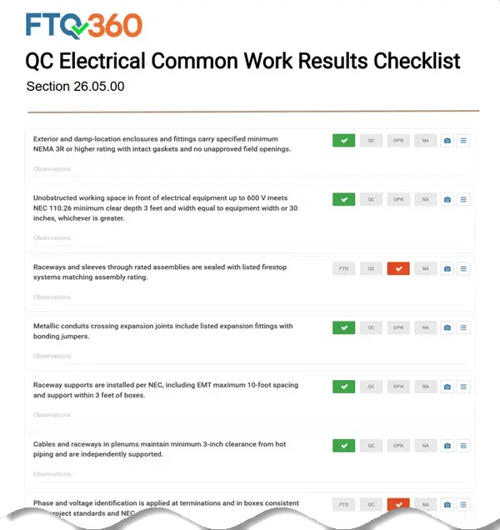
This Common Work Results for Electrical checklist tracks the field controls that make electrical work buildable, traceable, and safe before systems are energized.
You use it before rough-in to confirm approved submittals, study references, material releases, and coordination for penetrations, firestopping, access panels, and pads. At first article, it verifies the benchmark installation for fittings, pull wires, flexible connections, identification, and equipment pad geometry.
During production, it follows raceway types by environment, support conditions, bend limits, wiring workmanship, firestopping, and source-and-circuit tagging.
By closeout, it documents working clearances, grounding and bonding continuity, final labeling, underground identification, utility acceptance items, and repair of demolition or patching areas before final acceptance.
Checklist Preview

Common Failure Modes & Risk Prevention
This spec section has recurring field issues. Wrong fitting types usually come from convenience substitutions in the field, and they tend to show up later as loose connections, poor grounding continuity, and rework after walls or ceilings are closed.
Missing pull wires, inadequate slack, and deferred box labeling create a different problem: the rough-in may look complete, but conductor pulls, traceability, and future maintenance all become harder and less safe.
Unsupported raceways, weak anchors, and incomplete firestopping can also turn a routine installation into a punch-list or inspection failure once loads, penetrations, and surrounding finishes are in place.
Flexible connections without a separate ground and equipment pads built to the wrong dimensions create risk right at startup, where vibration, fault paths, anchorage, and equipment protection matter most.
The practical prevention focus is consistent, verify materials at receiving, lock down the first accepted installation, tag work as it progresses, and hold rated penetrations and energization until deficiencies are closed. These priorities drive the QAQC checks in the phases that follow.
Preparatory Phase
This phase takes place in the weeks before work begins. Prepare for success by verifying that personnel, materials, equipment, and documentation are ready for work to begin.
Before rough-in starts, make sure approved submittals, current one-line excerpts, and any affected study references are on site and tied to the work areas being released.
Review the raceway and application matrix by area so enclosure types and wiring methods match indoor, outdoor, damp, and concealed conditions before crews begin installation.
Confirm the receiving plan blocks the wrong products from reaching the field, including unapproved fittings, splicing methods, or enclosure ratings.
This is also where you coordinate support loading, future-capacity allowance on multi-run supports, penetrations, firestop details, access panels, and equipment pads before close-in.
If any of those fundamentals are unresolved, concealment should not proceed.

Initial Phase
This phase confirms that work starts correctly. Use the first accepted rough-in to establish the standard for the rest of the project.
That means confirming EMT is installed with compression fittings only, not set-screw fittings, and that the first empty raceway includes the required pull wire tensile strength and minimum 24-inch slack at each end.
Check the first flexible connection to vibrating equipment to verify the 12-inch minimum, 72-inch maximum, and separate grounding conductor.
Review the first identification sample for tape size, wrap count, engraved labels, and fastening method, and confirm the first equipment pad meets the required height, footprint extension, and specified mix class.
Concealment should stay on hold until that benchmark installation is accepted.
Follow-Up Phase
This phase aims to keep work proceeding correctly. As production moves, verify that raceway types still match the environment, approved fittings remain in use, and no exposed PVC appears above grade where it is not allowed.
Keep checking anchors, substrate conditions, support spacing, and independence from ceiling grid, ductwork, and piping. Track bend totals and pull-point layout so runs stay within limits, and inspect terminations for smooth reaming, compression splices, and undamaged conductor insulation.
At the same time, make source-and-circuit identification, firestop hold points, access panels, and equipment pads part of the routine inspection rhythm so missing details are corrected before close-in instead of surfacing at turnover.
Completion — Final Acceptance & Closeout
All of the work culminates with a final result; this phase ensures the completed installation meets project requirements.
Start the final walkdown by verifying required NEC 110.26 working clearances at electrical equipment and documenting the measured depth and width with location-tagged photos.
Confirm grounding and bonding continuity of metallic raceways and enclosures, with measured resistance to the grounding electrode system not exceeding 1 ohm and meter records tied to instrument identification and calibration status.
Make sure final labeling is complete across panels, switches, breakers, starters, cabinets, pull boxes, and junction boxes, and close out underground work with warning tape verification, spare-conduit destination labeling, and as-built markups.
Utility metering items, equipment pad readiness, and demolition or patching repairs also need documented acceptance before energization. If clearance, grounding, labeling, or firestop deficiencies remain open, energization should not move forward.
References and Other Specification Systems
References
NFPA 70 (current adopted edition)
Utility company published metering standards where applicable
Other Specification Systems
UFGS 26 05 00 Common Work Results for Electrical
VA 26 05 00 Common Work Results for Electrical
NMS 26 05 00 equivalent to be verified
RIB SpecLink 26 05 00 equivalent to be verified
Related inherited controls from 26 05 19, 26 05 26, 26 05 29, and 26 05 33
FTQ360 Inspection & QAQC Platform
FTQ360 runs on tablets and phones (online or offline), allowing inspectors to capture photos and measurements at the point of work.
Required fields and conditional logic prevent skips and enforce holds. Time/user stamps and lot/location links keep the record auditable.
Dashboards surface patterns within a few installs, so you can correct fitting substitutions, identification gaps, or firestop misses before they multiply across areas.
How to Use the Free Template (quick start)
Prefer the FTQ360 in-app setup?
Open Checklist Setup → Library, search for the code and tap to clone the checklist.
Then tailor checkpoint templates to your requirements.
If your team still needs paper in select areas, you can print the PDF from the FTQ360 app, mark it up in the field, then transcribe results and attach photos later, just note that paper won’t enforce required fields, conditional logic, or holds like the app does.
For step-by-step help, visit support.ftq360.com.
MasterSpec® and MasterFormat® are registered trademarks. This blog references section numbers and titles for clarity only and does not reproduce proprietary content. Copyright FTQ360.