

Purpose & Scope
Section 26.05.19 covers low-voltage electrical power conductors and cables used for building power distribution, including copper and aluminum building wire, MC and AC cable, tray cable, PV cable, MI cable, fire-alarm wire and cable, and related connectors and splices.
You are managing more than wire pulls here; you are controlling installation, integration, safe operation, and the documented quality of the full conductor system before energization and turnover.
The checklist follows the three-phase QAQC control flow, Preparatory, Initial, and Follow-Up, to keep the work aligned from pretask planning through production and closeout.
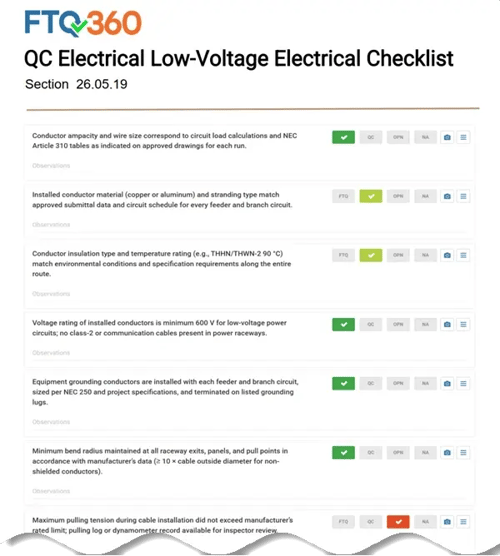
The FTQ360 version includes required photos, numeric measurements, and sign-offs so you can build an auditable record of conductor selection, pulling, terminations, testing, and corrective action.
What the Checklist Covers
This low-voltage electrical power conductors and cables checklist tracks the work from preconstruction planning through final acceptance.
You use it to confirm approved product data, manufacturer installation instructions, and conductor application requirements before wire pull starts, then to verify raceway readiness, pull planning, reel identification, splice and termination compatibility, and installer qualifications.
During first-article installation, the checklist documents conductor type, insulation, pull conditions, terminations, splice methods, slack at outlets, and identification standards so production starts from an accepted benchmark.
As work continues, it helps you control damage prevention, routing consistency, parallel-feeder balance, torque records, aluminum termination practices, and field documentation.
By closeout, it captures visual inspection results, insulation-resistance and continuity testing, resistance balance checks, infrared scan requirements where retained, and the full turnover package.
Checklist Preview

Common Failure Modes & Risk Prevention
This spec section has recurring field issues. This section has a long history of problems that usually start with poor pull planning, connector mismatch, weak identification discipline, or missed documentation during production.
Insulation damage often traces back to excessive pulling tension, sidewall pressure, or sharp edges at raceway entries, and the field signs usually appear later as failed megger readings, damaged jackets, or startup delays.
Lug and splice failures typically come from the wrong barrel material, wrong size, or incorrect crimp tooling, which then show up as overheating and premature terminations.
Parallel feeder imbalance, missing oxide inhibitor on aluminum, and concealed splices outside approved enclosures create harder-to-find reliability and maintenance risks.
Identification failures do not always stop installation immediately, but they make troubleshooting slower and less safe once the system is energized. These priorities drive the QAQC details that follow.
Preparatory Phase
This phase takes place in the weeks before work begins. Prepare for success by verifying that personnel, materials, equipment, and documentation are ready for work to begin.
Before any conductors are installed, you need approved product data, manufacturer installation instructions, and a product schedule showing conductor type, use, location, and termination points.
This is also where you confirm testing-agency qualifications where required, verify that assigned installers have the required experience, and check that reels and cartons carry intact listing and identification marks.
Your pull plan should already define raceway readiness, lubricant, bend-radius control, pulling direction, and maximum tension and sidewall pressure limits.
Splice and termination planning matters just as much: listed lugs and splice kits must match conductor material and size, torque tools must be calibrated, and oxide inhibitor must be staged for aluminum work.
When these controls are set before the first pull, you reduce the same failure risks that later show up as damaged insulation, overheating terminations, and avoidable rework.

Initial Phase
This phase confirms that work starts correctly. The first feeder or branch-circuit pull establishes the production benchmark, so you verify conductor material, stranding, insulation type, and voltage rating against approved schedules and reel markings before the work advances.
The first pull should also prove that the approved lubricant and pulling means are not damaging conductor or raceway and that recorded pulling tension stays within manufacturer limits.
At the first terminations, you confirm listed lugs matched to conductor material and size, full strand engagement, and torque to published values or UL 486A-486B where manufacturer values are not given.
First splices, taps, outlet-box slack, and conductor identification should be checked closely and corrected immediately so the accepted standard is clear before full production continues.
Follow-Up Phase
This phase aims to keep work proceeding correctly. As production continues, you verify that raceways are complete before pulling, conductors are protected from sharp edges and over-bending, and pull logs stay current for designated circuits.
You also keep watching for insulation or jacket damage, unequal parallel-feeder routing, missing torque records, improper aluminum termination practice, and splices made outside listed boxes or kits.
Follow-Up is where routine verification protects consistency: conductor identification stays current at pull boxes and panels, derating reviews are completed where conductor fill requires them, and corrections are made before concealed or energized work carries forward a repeated defect.
Completion — Final Acceptance & Closeout
All of the work culminates with a final result; this phase ensures the completed installation meets project requirements.
Before energization, you verify physical condition, correct connections, conductor identification, cable jacket condition, and compression-connector match for the required conductor sets.
Insulation-resistance testing, continuity testing, and uniform resistance checks for parallel conductors must be complete and documented, along with high-resistance checks by low-resistance ohmmeter, calibrated torque wrench, or thermographic survey as applicable.
Where retained by project requirements, initial infrared scanning of splices in larger conductors must be completed, deficiencies corrected, and results documented before final acceptance.
The closeout package should assemble field quality-control reports, test procedures, compliant and noncompliant results, corrective actions, reel-to-circuit traceability, and any required Company Field Advisor affidavit.
Energization should not proceed with open deficiencies in identification, torque verification, megger results, continuity, or feeder balance.
References and Other Specification Systems
References
NFPA 70 (current adopted edition)
Other Specification Systems
UFGS 26 05 19 — Low-Voltage Electrical Power Conductors and Cables
VA 26 05 19 — Low-Voltage Electrical Power Conductors and Cables
NMS 26 05 19 equivalent to be verified for project region and edition
RIB SpecLink 26 05 19 equivalent to be verified
Related child sections: 26 05 19.13 Undercarpet Electrical Power Cables; 26 05 19.23 Manufactured Wiring Assemblies
Related coordination sections: 26 05 26 Grounding and Bonding for Electrical Systems; 26 05 33 Raceways and Boxes for Electrical Systems; 26 05 53 Identification for Electrical Systems; 26 05 44 Sleeves and Sleeve Seals for Electrical Raceways and Cabling
FTQ360 Inspection & QAQC Platform
FTQ360 runs on tablets and phones (online or offline), allowing inspectors to capture photos and measurements at the point of work.
Required fields and conditional logic prevent skips and enforce holds. Time/user stamps and lot/location links keep the record auditable.
Dashboards surface patterns within a few pulls and terminations, so you can adjust handling and installation before defects propagate.
How to Use the Free Template (quick start)
Prefer the FTQ360 in-app setup?
Open Checklist Setup → Library, search for the code and tap to clone the checklist.
Then tailor checkpoint templates to your requirements.
If your team still needs paper in select areas, you can print the PDF from the FTQ360 app, mark it up in the field, then transcribe results and attach photos later, just note that paper won’t enforce required fields, conditional logic, or holds like the app does.
For step-by-step help, visit support.ftq360.com.
MasterSpec® and MasterFormat® are registered trademarks. This blog references section numbers and titles for clarity only and does not reproduce proprietary content. Copyright FTQ360.