

Purpose & Scope
The HB.04.00 Final Residential Interior checklist helps production homebuilders verify that the interior of the home is ready for homeowner acceptance. This checklist addresses final owner-ready review of interior finishes, fixtures, appliances, doors, cabinets, trim, hardware, safety devices, utilities, documentation, cleanliness, and correction closure before the home advances to customer review.
For a production builder, final residential interior review is where construction quality becomes homeowner-visible quality. The buyer may not see the work sequence behind the walls, but they will see whether doors operate correctly, cabinets align, finishes are clean, fixtures are complete, appliances match the selection, devices are installed, the breaker panel is labeled, homeowner materials are ready, and the home feels complete. When interior release is rushed, late defects become walkthrough items, closing friction, warranty exposure, and superintendent distraction.
The checklist gives the superintendent, QA team, and trade partners a structured way to confirm that each room and customer-facing interior condition has been reviewed, failed items have been assigned and corrected, required documents and owner materials are ready, and the home is prepared for homeowner acceptance without carrying unresolved quality risk forward.
Checklist Preview
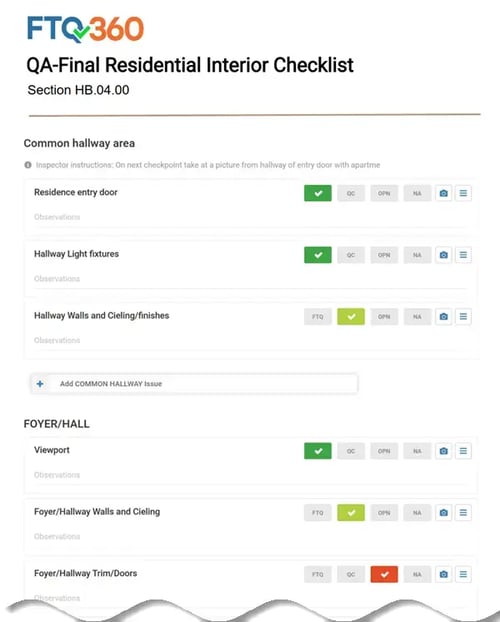

What the Checklist Covers
This checklist begins with the task-specific information needed to evaluate final residential interior readiness. Current builder plans, finish schedules, interior selections, option and change-order records, appliance schedules, and customer-specific selections should match the lot, plan type, and community release package. The inspection record should link the approved documents so the final review is performed against the correct current information. If revisions conflict, the home should not advance to homeowner review.
The checklist then defines the room-by-room review route. Entry, foyer, hallways, kitchen, laundry, bedrooms, bathrooms, living areas, utility spaces, closets, low-voltage locations, and customer handoff areas should be included in the inspection scope. A lot-specific room list or checklist scope map helps prevent missed areas, especially in repeated plan types where similar rooms can be easy to assume rather than verify.
Trade responsibility is also built into the checklist. Finish carpentry, doors, trim, cabinets, countertops, flooring, tile, plumbing, electrical, HVAC, appliances, low voltage, fireplace, cleaning, and customer-handoff documentation each have distinct release responsibilities. The checklist should identify the correction owner before the final review starts so open work does not become an unresolved handoff dispute between trades.
The physical inspection confirms room-by-room interior readiness. Visible finishes, fixtures, appliances, doors, cabinets, trim, flooring, windows, walls, ceilings, closets, utility interfaces, safety devices, and low-voltage locations are passed, failed, or marked not applicable with room and location evidence. Plumbing fixtures, faucets, disposals, toilets, laundry plumbing, appliance water connections, electrical devices, light fixtures, smoke detectors, breaker panel labeling, security, internet, cable locations, HVAC controls, air handler, condensate lines, registers, and visible final interfaces are verified separately from general finish checks.
The checklist closes with customer-ready release conditions. Required homeowner materials, warranty packages, touch-up kits, tile replacements, appliance documents, HVAC and heater packages, and lot-specific handoff materials should be complete, labeled, and ready for walkthrough. All failed items should be closed with reinspection evidence or carried as approved exceptions before the home advances.
Why This Stage Matters for Production Builders
Final residential interior review matters because it is the last broad interior quality gate before the buyer experience. By this stage, most major work is complete, but customer-visible defects can still be numerous if room-by-room release is not disciplined. A missing device cover, damaged cabinet, wrong appliance, unlabeled electrical panel, leaking fixture, incomplete HVAC control, poor finish touch-up, missing warranty package, or dirty room can all create the same buyer perception: the home was not ready.
The production risk is magnified by repetition. Production builders repeat plans, selections, trade scopes, release groups, superintendent routines, and customer walkthrough processes. If the final interior review catches recurring defects early, the builder can correct the issue before it spreads. If the review relies on informal punch notes, a repeated trade failure can move through multiple lots and communities before the pattern becomes visible.
HB.04.00 should therefore be treated as a stage-release inspection for homeowner acceptance. The home should not move forward because a walkthrough date is approaching. It should move forward because every required interior area has a pass, fail, or not-applicable status; failed items have correction evidence; safety and utility interfaces are verified; required owner materials are complete; and the completed record supports release. A disciplined final residential interior process protects closing readiness, lowers warranty exposure, reduces defect count and severity at walkthrough, and strengthens trade partner accountability.
Common Failure Modes & Risk Prevention
Incomplete owner-ready finish is one of the most common final interior risks. It usually results from late trade damage, missed room-by-room verification, or assumed completion based on prior punch activity. The consequence is a higher defect count at walkthrough and added closing friction. Prevention depends on inspecting each room and location before customer scheduling, tagging visible defects, assigning correction ownership, and closing deficiencies with photo evidence before release.
Wrong selections, colors, appliances, cabinets, fixtures, or hardware usually begin with an outdated selection sheet, missed option change, or incomplete lot-specific review. These failures create replacement work, customer dissatisfaction, and schedule disruption. Prevention starts with confirming the current selections, option records, appliance schedule, and finish schedule before final review. Verification should include selection references and item photos where mismatches would affect homeowner acceptance.
Plumbing leaks and incomplete hookups are especially risky because they can damage accepted finishes and become immediate warranty callbacks. Kitchen faucets, disposals, toilets, bathroom plumbing, laundry plumbing, appliance water connections, and drains should be operated or visually verified where applicable. Any active leak should stop release until corrected and reinspected.
Unsafe or incomplete electrical and safety-device conditions should not be treated as general finish punch. Light fixtures, receptacles, switches, smoke detectors, breaker panel labels, security, internet, cable locations, low-voltage devices, and final covers need separate verification. Missing, unsafe, or unlabeled electrical equipment should stop advancement until corrected because it affects both homeowner acceptance and release readiness.
HVAC control, air-handler, register, and condensate issues can surface late when startup or final-system status is not linked to interior release. Missing controls, incomplete condensate routing, equipment concerns, or unresolved startup evidence can create comfort complaints, water damage, and callbacks. Prevention depends on verifying visible HVAC interfaces and linking final interior release to the applicable startup or functional record.
Repeated interior failures across rooms, lots, plan types, communities, or trade partners create the largest production risk. A recurring cabinet issue, finish defect, missing device condition, appliance mismatch, cleaning gap, or handoff-document problem should be coded by trade partner, room type, plan type, community, and superintendent before additional lots are released. Trend visibility turns final interior punch from a one-home cleanup exercise into a production-control process.
Before Work Advances
Before final residential interior review begins, the builder needs the right information, scope, responsible parties, and release prerequisites in place. Current builder plans, finish schedules, interior selections, option and change-order records, appliance schedules, and customer selections should match the lot being inspected. If the review starts with conflicting revisions, the inspection can create confusion instead of release confidence.
The inspection route should be complete before the review starts. Entry, foyer, hallways, kitchen, laundry, bedrooms, bathrooms, living areas, utility spaces, closets, low-voltage locations, fireplace areas, mechanical or utility locations, and customer-handoff materials should be included where applicable. A lot-specific room list helps ensure that repeated or optional spaces are not skipped.
Trade partners should be identified with correction responsibility before the review begins. Finish carpentry, cabinets, countertops, flooring, tile, drywall and paint, plumbing, electrical, HVAC, appliances, low voltage, fireplace, cleaning, and customer-handoff documentation may all affect the same owner-ready release decision. The checklist should identify who owns each correction and what evidence is required for closure.
Prior drywall, paint, trim, MEP rough-in, startup, and trade punch items should be closed or carried forward as approved exceptions before customer-review scheduling. Municipal, builder, or third-party release prerequisites needed before homeowner review should also be listed with status. This setup step confirms that the final interior review is not starting on top of unresolved or unassigned conditions that should have been closed before release.
Job-Ready Verification
Job-ready verification confirms that prerequisite information and handoff conditions are acceptable before the current stage proceeds. For HB.04.00, this means the builder verifies that the first owner-ready interior area demonstrates the expected finish quality, cleanliness, functional readiness, and evidence-capture standard before the broader final review expands across the home.
The first reviewed interior area should confirm that walls, ceilings, flooring, trim, doors, hardware, cabinets, countertops, fixtures, devices, and visible final conditions are ready to be judged under the current plan type and finish standard. Location-tagged photos and an initial pass/fail record establish the inspection standard for the rest of the home. If the first area reveals unresolved finish, cleaning, functional, or documentation issues, comparable areas should be checked before additional release decisions are made.
The first sample of each major interior category should also be verified against selections and manufacturer requirements where applicable. Doors, trim, cabinets, countertops, flooring, plumbing fixtures, electrical devices, appliances, HVAC controls, low-voltage locations, safety devices, and fireplace components should match the current lot-specific information and be ready for customer-facing review. Tagged photos and selection references help prevent wrong-item approvals from becoming accepted conditions across the home.
The first failed checkpoint should be assigned to the correct trade partner with correction scope, due date, and reinspection evidence requirement before additional customer-facing areas are released. This prevents the final review from becoming a long informal punch list with unclear ownership. If a repeated defect pattern appears, the builder should evaluate whether the same issue affects the same plan type, elevation, trade crew, release group, or community before the defect becomes normalized across the production cadence.
Progress Preview
During final interior correction work, progress preview checks help the builder keep the release process moving without losing control of quality. These checks are useful because they surface issues while corrections are still practical, but they do not authorize homeowner review by themselves. Their purpose is to reduce surprises at the final stage-release decision.
As room-by-room review proceeds, each visible finish, fixture, appliance, door, cabinet, trim, flooring, window, wall, ceiling, closet, utility condition, and handoff item should be passed, failed, or marked not applicable with room and location evidence. Blank statuses should not be carried forward because they leave uncertainty about whether the condition was inspected or simply missed.
Correction work should remain protected from trade damage. Before-and-after photos tied to deficiency IDs help show that repaired areas were actually reinspected. Cleaning, touch-up, protection removal, and trade debris removal should not damage accepted finishes or mask remaining defects. If cleaning creates new homeowner-visible issues, the home is not ready for release.
Functional and safety-related conditions should be verified separately from general finish observations. Plumbing fixtures, faucets, disposals, toilets, laundry plumbing, and appliance water connections should be operated or visually verified where applicable. Electrical devices, light fixtures, smoke detectors, breaker panel labeling, security, internet, and cable locations should receive separate pass records. HVAC air handler, condensate line, control unit, registers, and visible final interfaces should be supported by equipment or control photos and linked startup or functional evidence where required.
Progress preview also helps the builder catch recurring patterns before the release group advances. If repeated failures appear by trade partner, crew, room type, plan type, community, or superintendent, the builder can review related lots before the same defect reaches homeowner walkthrough. This protects closing readiness and gives trade partners a chance to correct the process rather than only repairing individual symptoms.
Stage Release & Homeowner Acceptance Readiness
Stage release is the governing inspection event for HB.04.00. The home is ready for homeowner acceptance only when required final interior checkpoints are complete, failed items are closed with reinspection evidence, approved exceptions are documented, and the completed record supports advancement.
The final release record should confirm that all rooms and applicable customer-facing areas have been reviewed against the lot-specific room list. Entry, foyer, hallways, kitchen, laundry, bedrooms, bathrooms, living areas, closets, utility spaces, low-voltage locations, fireplace areas, and customer-handoff items should have documented status. Visible finish, door, hardware, trim, cabinet, countertop, flooring, tile, wall, ceiling, window, closet, and cleanliness conditions should be complete, aligned, clean, undamaged, and ready for homeowner review.
The release should also confirm functional readiness. Plumbing fixtures and appliance water or drain connections should be complete and leak-free where applicable. Electrical fixtures, receptacles, switches, smoke detectors, breaker panel labels, warranty sticker, and final covers should be complete and clean. HVAC equipment, controls, registers, condensate lines, and final interior interfaces should be coordinated with startup or final-system records. Low-voltage, security, internet, and cable locations should be present, clean, and aligned with customer selections where applicable. Appliance and fireplace documentation should be ready where required.
Owner handoff materials should be verified before release. Warranty packages, appliance documents, HVAC and heater materials, tile replacements, paint or touch-up kits, manuals, and builder-required homeowner materials should be complete, labeled by lot, and ready for walkthrough. If required owner materials are missing, the home should not be treated as fully owner-ready.
If a checkpoint fails, the inspection record should identify the room or area, failed condition, responsible trade partner, correction owner, correction evidence, and reinspection result. Open items that affect homeowner review, closing readiness, warranty exposure, safety, utility function, or defect severity perception should stop release until corrected or formally approved as an exception.
For production builders, the completed release record becomes trend data. When failures are tracked by trade partner, crew, room type, plan type, community, superintendent, and defect category, the builder can see whether a final interior issue is isolated or beginning to repeat. That visibility helps prevent customer-facing defects from spreading across release groups and becoming larger closing or warranty problems.
References and Related Specification Systems
References
Primary reference inputs for this checklist include approved builder plans, finish schedules, interior selections, option and change-order records, lot-specific customer selections, appliance schedules, manufacturer installation and operation instructions, warranty documentation, startup instructions, and project-adopted residential building, electrical, mechanical, plumbing, fire/life-safety, energy, and municipal final-inspection requirements. Applicable jurisdiction, edition, and project requirements should be verified before treating any reference as controlling.
Related Specification Systems
Related specification systems may include interior finishes, doors and hardware, millwork, cabinets, countertops, flooring, tiling, painting, plumbing fixtures, electrical devices, HVAC equipment and controls, appliances, low-voltage systems, fireplaces, cleaning, warranty documentation, owner handoff, and closeout. UFGS, VA Master, NMS, and RIB SpecLink equivalents should be verified against actual project requirements before being used. The Homebuilder checklist does not assume a direct one-to-one commercial specification counterpart. Applicability should always be confirmed against the builder’s standards, jurisdiction, project documents, and lot-specific conditions.
FTQ360 Inspection & QAQC Platform
FTQ360 helps production builders manage final residential interior inspections as repeatable stage-release controls for homeowner acceptance. Inspectors can complete the HB.04.00 checklist on phones or tablets, tag defects by room and location, attach location-tagged photos, identify failed checkpoints, assign responsible trade partners, document correction ownership, record reinspection status, and capture superintendent or QA signoff before the home advances.
Required fields, photo evidence, room lists, correction assignments, and release status help prevent customer-review decisions from depending on memory, informal punch notes, or verbal trade updates. Time stamps and user stamps show who verified the home and when. Community, lot, plan type, room type, trade partner, crew, superintendent, defect category, defect severity, recurrence tags, and correction status make recurring final interior issues easier to see before they spread across the production cadence.
For homebuilders, the value is not simply replacing a paper punch list. The value is knowing which homes passed, which rooms failed, which corrections remain open, which trade partners own the work, which homeowner materials are ready, which homes can advance to customer review, and where recurring quality risk is emerging before it affects closing readiness, warranty exposure, or homeowner confidence.
How to Use the Free Template
For the fastest digital setup, open FTQ360 Checklist Setup, go to the Library, search for HB.04.00 Final Residential Interior, and clone the checklist.
Then tailor the checkpoint templates to your builder standards, room and area naming conventions, plan types, customer-selection workflow, community requirements, trade responsibilities, municipal or third-party release process, required photo documentation, and homeowner-acceptance process.
If your team still uses paper in selected areas, the checklist can also support field markup and later transcription. Paper can capture observations, but it cannot enforce required fields, correction ownership, photo evidence, reinspection status, release status, customer-handoff completeness, or recurring-defect visibility the way a digital QAQC workflow can.
For step-by-step help, visit support.ftq360.com.
FTQ360 inspection and QAQC software helps homebuilders verify job readiness, make disciplined homeowner-acceptance release decisions, prevent repeat interior defects, strengthen trade partner accountability, and protect closing readiness through consistent field evidence.
MasterSpec® and MasterFormat® are registered trademarks. This blog references related specification systems for clarity only and does not reproduce proprietary content. Copyright FTQ360.