

Purpose & Scope
The HB.05.00 Pre-Drywall Frame and MEP checklist helps production homebuilders verify that concealed framing, blocking, firestopping, rough mechanical, electrical, plumbing, low-voltage, roof and exterior opening details, and inspection-release conditions are ready before insulation or drywall cover begins.
For a production builder, pre-drywall review is one of the most important no-cover stage-release decisions in the entire build cycle. Once insulation and drywall are installed, many framing, routing, protection, flashing, fireblocking, duct, pipe, wire, and option-upgrade conditions become difficult to see, expensive to prove, and disruptive to correct. A missing nail plate can become a concealed pipe or wire strike. A mislocated electrical box can become a drywall cut-in. An unsupported duct or unsealed boot can become a comfort complaint. A missing block behind a future fixture can become finish rework. An undocumented municipal or third-party release can turn a scheduled cover activity into a reinspection delay.
The checklist gives the superintendent, QA team, and trade partners a structured way to confirm that framing and rough-in work is complete, visible, accessible, photographed, corrected, externally released where required, and ready to advance without carrying concealed quality risk into insulation or drywall.
Checklist Preview
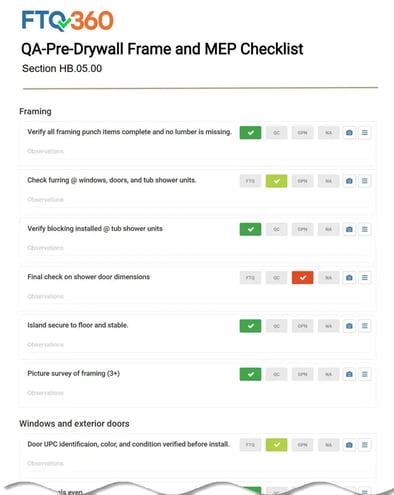

What the Checklist Covers
This checklist begins with the task-specific information needed to evaluate pre-drywall readiness. The current plan set, structural details, exterior opening details, roof and flashing details, MEP rough plans, low-voltage and security plans, option and upgrade sheets, and builder community standards should be available by lot, plan type, elevation, trade partner, crew or foreman, and release group before insulation or drywall is scheduled.
The checklist also confirms that trade partners understand the no-advance conditions for the stage. Framing, roofing and flashing, HVAC, plumbing, electrical, low-voltage, fireplace or direct-vent, and site trade partners should know what must be complete, what evidence is required, and what correction closure is needed before cover. Manufacturer installation instructions should be available where applicable for exterior doors and windows, tubs and showers, HVAC equipment, duct systems, direct-vent or fireplace units, roofing and flashing, appliance vents, and related rough-in assemblies.
The physical inspection covers the conditions that must remain visible before concealment. Each room, wall line, story, and exterior opening should be inspected while framing and MEP rough-in are still accessible. Framing, furring, and blocking should be complete at windows, doors, tub and shower units, islands, fireplace and mantel locations, and required attachment points. Exterior doors, roof flashing, boots, crickets, drip edge, shingles, nail heads, and water-shedding details should be complete before interior cover makes rework more difficult.
The checklist also verifies rough mechanical, plumbing, electrical, and low-voltage work. HVAC rough-in is reviewed for duct layout, sealed ducts, supported flexible ducts, open dampers, condensate fall, flue clearances, outside-terminated bath vents, dryer vent location, protected line sets, and secured supply boot strapping. Plumbing rough-in is reviewed for nail and staple protection, water and drain line protection, pressurized water service, tub level and support, capped shower stubs, water meter and hookup status, refrigerator box location, and pipe location within walls. Electrical and low-voltage work is reviewed for box locations, cable routing, cable support, protective nail plates, smoke detector lines, buyer upgrades, countertop receptacles, alarm, internet, and CATV locations.
The checklist closes with release conditions. Municipal framing and MEP rough inspections, plus any third-party energy, fireblocking, or pre-drywall release requirements, should be documented separately from the builder’s internal pass status. Framing, plumbing, electrical, HVAC, low-voltage, roofing and flashing, and fireplace or direct-vent corrections should be assigned, photographed, reinspected, and closed before insulation or drywall begins.
Why This Stage Matters for Production Builders
Pre-drywall review matters because it is the last broad opportunity to inspect many of the conditions that control structure, comfort, utility performance, safety, weather protection, and future homeowner satisfaction. After cover, a missed rough-in condition no longer looks like a field correction. It becomes destructive rework, finish repair, schedule disruption, or warranty exposure.
The production risk is magnified by repetition. Production builders repeat plans, elevations, option packages, trade partners, crews, rough-in methods, and community release sequences. When the pre-drywall process is disciplined, that repetition creates predictable quality. When a concealed-condition failure is missed, the same issue can spread across multiple lots before the pattern is recognized.
This is why HB.05.00 should be treated as a stage-release control, not a quick walk before drywall. The home should not advance because the drywall crew is scheduled. It should advance because framing, MEP rough-in, exterior opening details, fireblocking, photo surveys, municipal releases, third-party releases where required, and correction closure are complete. A clean pre-drywall release protects cycle time, reduces destructive rework, strengthens trade partner accountability, and helps prevent concealed defects from becoming closing delays or warranty claims later.
Common Failure Modes & Risk Prevention
Open framing punch items, missing blocking, or incomplete furring often remain when schedule pressure pushes the home toward drywall before trade corrections are complete. The consequence can be drywall rework, fixture conflicts, visible finish defects, and warranty exposure. Prevention depends on confirming framing punch closure and photo evidence before cover. Missing blocking at tub and shower units, islands, fireplace and mantel locations, or other required attachment points should stop release for the affected area until corrected and reinspected.
Unprotected or mislocated plumbing lines create serious concealed-risk exposure. Missing nail guards, field routing changes, unverified pressure or readiness evidence, unsupported tubs, or unclosed shower stubs can lead to concealed leaks, drywall removal, callbacks, and homeowner disruption. Prevention depends on checking nail and staple guards, water and drain line protection, pipe locations within walls, water meter status, water and sewer tie-in, refrigerator box height, tub level and support, shower cap condition, and pressure or readiness evidence before cover.
Electrical and low-voltage failures often come from plan mismatch, missed buyer upgrades, or incomplete rough-in review. Mislocated boxes, missing protective plates, unsupported cables, missing smoke detector lines, omitted internet or CATV outlets, or missing countertop receptacles can create failed inspection, drywall cut-ins, closing friction, and customer dissatisfaction. Prevention depends on comparing rough-in conditions to the current plan and upgrade documents, verifying box locations and heights, confirming that wires remain within wall cavities, and documenting the electrical and low-voltage photo survey.
HVAC rough-in failures can remain hidden until comfort, condensate, or ventilation problems appear later. Unsupported flexible ducts, unsealed boots or plenums, closed dampers, inadequate condensate fall, improper flue clearance, misrouted bath or dryer vents, unprotected line sets, or incomplete control wiring can become energy defects, comfort complaints, moisture damage, or life-safety concerns. Prevention depends on verifying duct layout, mastic seal, support interval, condensate fall, vent termination, flue clearance, line-set flashing, and thermostat or control-wire location before cover.
Incomplete exterior opening, roof, boot, cricket, drip-edge, or flashing details can carry water risk into concealed assemblies. These failures often begin with skipped manufacturer instructions, poor trade handoff, or missed roof and exterior-opening photo evidence. Prevention depends on verifying that door flashing directs water outside, roof flashing and boots are installed and sealed, crickets are installed where needed, nail heads are sealed, drip edge is undamaged, and water-shedding details can be documented before interior cover proceeds.
Incomplete fireblocking, firestopping, draftstopping, or penetration protection is a no-cover risk because the condition may be hidden by insulation or drywall. These failures often occur at trade interfaces where responsibility is unclear. Prevention depends on assigning responsibility by location, capturing photo evidence, and reconciling municipal or internal release status before any concealed life-safety condition is covered.
Assumed municipal or third-party release is another common failure mode. Internal readiness does not replace required AHJ, energy, fireblocking, or pre-drywall release documentation. The checklist prevents false readiness by requiring separate documentation of framing, plumbing rough, electrical rough, mechanical rough, low-voltage, and required third-party release status before downstream scheduling proceeds.
Before Work Advances
Before the pre-drywall review begins, the builder needs the right information, trade readiness, inspection sequence, and evidence plan in place. Current plans, structural details, option and upgrade sheets, MEP rough plans, low-voltage plans, roof and flashing details, exterior opening details, and builder standards should match the lot being inspected. If the review starts from outdated drawings or incomplete option information, the inspection can miss the very conditions that will become expensive after cover.
The inspection scope should be organized by lot, community, plan type, elevation, release group, trade partner, and crew or foreman. Each room, wall line, story, exterior opening, roof detail, fireplace or direct-vent location, and rough-in area should be included where applicable. A pre-cover photo evidence plan should identify required photo locations for framing, roof and flashing, HVAC, plumbing, electrical, low-voltage, and general jobsite surveys.
Trade responsibilities should be clear before the walk. Framing, roofing and flashing, HVAC, plumbing, electrical, low-voltage, fireplace or direct-vent, and site trade partners should know the correction evidence required for release. If a failed condition belongs to more than one trade, the checklist should identify the responsible correction owner rather than leaving the item unresolved.
Municipal framing and MEP rough inspections, plus any third-party energy, fireblocking, or pre-drywall release requirements, should be coordinated before cover. The builder’s internal pass status should be reconciled with external release results. No drywall, insulation cover, or downstream trade release should be planned until open corrections, pressure-test evidence, photo surveys, and municipal or third-party release records are complete.
Job-Ready Verification
Job-ready verification confirms that prerequisite work and handoff conditions are acceptable before the current stage proceeds. For HB.05.00, this means the builder verifies that representative framing, exterior opening, MEP rough-in, low-voltage, fireblocking, and inspection-release conditions are acceptable before the pre-drywall release process scales across the lot or release group.
For a plan type, new trade crew, changed detail, or new community phase, the first active work should receive close review before the method repeats across additional homes. Framed areas, windows, doors, tub and shower units, roof penetrations, fireplace or direct-vent locations, and required blocking locations should be checked for plan match, plumb and level condition, installation depth, flashing path, and attachment readiness. Location-tagged photos should show the condition before the balance of the work is treated as acceptable.
The first HVAC rough-in run should verify duct layout, unit placement, open dampers, mastic seal at boots and plenums, condensate fall of 1/4 inch per foot, 4-foot support intervals where required, flue clearance, bath and dryer vent routing, line-set protection, and thermostat or control-wire location. These items should be documented with HVAC inspection photos and measured notes where applicable.
The first plumbing rough-in area should verify stud and nail guards, water and drain line protection, tub level and support, shower stub cap, water meter or hookup status, refrigerator box height, and pipe location within walls. Pressure or test evidence should be documented before cover. The first electrical and low-voltage rough-in area should verify box locations within 1/2 inch where required, cable routing within wall cavities, protective plates, staples or supports, smoke detector lines, alarm, internet and CATV locations, and buyer option or upgrade receptacles.
Job-ready verification also reconciles inspection release status. The first municipal or third-party inspection result should be compared with the builder’s internal readiness record before advancement. If a repeated failure appears in the first reviewed area, the builder should review the same plan type, crew, and release group before more lots are covered.
Progress Preview
During active pre-drywall preparation, progress preview checks help the builder surface issues while they are still visible and easier to correct. These checks are practical and important, but they do not authorize insulation or drywall by themselves. Their purpose is to reduce surprises at the final stage-release decision.
As framing and rough-in work progresses, each room, wall line, story, and exterior opening should be inspected before concealment. Framing, furring, and blocking should remain complete at windows, doors, tub and shower units, islands, fireplace and mantel locations, and required attachment points. Missing blocking or incomplete furring should be corrected before the condition is hidden.
Exterior opening and roof details should remain documented as work advances. Exterior doors should be identified, level, plumb, square, centered, and installed to the proper depth for final trim conditions. Door operation and reveals should be checked. Roof flashing, boots, crickets, drip edge, shingles, sealed nail heads, and other water-shedding details should remain complete and photographable before interior cover proceeds.
Mechanical, plumbing, electrical, and low-voltage rough-ins should be checked separately by scope. HVAC duct routing, supports, seals, dampers, condensate slope, flue clearance, bath and dryer vent termination, line-set flashing, and control wiring should remain complete. Plumbing protection, tub support, water and sewer tie-ins, pipe locations, nail guards, pressure evidence, and shower caps should remain verified. Electrical and low-voltage boxes, cables, smoke detector lines, protective nail plates, upgrade locations, countertop receptacles, internet, CATV, and alarm locations should be compared to current plans and options.
Fireblocking, firestopping, draftstopping, and penetration protection should remain visible and complete where required before cover. Jobsite rough grade, access, and debris control should also remain adequate for safe inspection and downstream work. When deficiencies are found, they should be assigned to the responsible trade partner, corrected, photographed, and reinspected before the stage-release decision.
Progress preview also helps identify repetition. If the same failed checkpoint appears on more than one lot, plan type, trade partner, crew, or release group, the builder should pause the repeated condition, review affected lots, and confirm the corrected method before the defect scales across production.
Stage Release & Pre-Drywall Cover Readiness
Stage release is the governing inspection event for HB.05.00. The home is ready for insulation or drywall cover only when required pre-drywall conditions have passed, failed items have been corrected, external releases are documented where required, and the completed record supports advancement.
The release record should confirm that framing punch items are closed, no lumber is missing, furring is complete at windows, doors, and tub and shower units, blocking is installed where required, shower door dimensions are checked where applicable, islands are secured, and framing photo surveys are uploaded. Fireplace and direct-vent conditions should verify blocking for fireplace and mantel installation, vent cover condition, gas stub and electrical box locations, manufacturer installation requirements, unit level, plumb, square, centered condition, installation depth, combustible clearance, control wiring, and firestopping or fireblocking requirements where applicable.
The release should also confirm that exterior openings, roof, and water-shedding details are complete before cover. Exterior doors should match the approved identification, color, and condition; reveals should be even; doors should operate smoothly; and flashing should direct water outside. Roof flashing, sealed nail heads, crickets where needed, properly installed boots, undamaged drip edge, straight shingles, neat gable cuts, and roof-detail photo surveys should be complete.
Mechanical release conditions should be documented before cover. HVAC duct design, unit placement, duct layout, open dampers, mastic sealing at boots and plenums, condensate line fall of 1/4 inch per foot, 4-foot support intervals where required, flue clearance, B-vent condition where applicable, flexible duct support, bath vent termination, dryer vent location, line-set flashing, supply boot strapping, refrigerant line condition, thermostat location, control wiring, and HVAC photo survey should be complete and closed.
Plumbing release conditions should be documented before cover. Stud guards and nail guards should be complete, drain and water lines should be protected from nail or staple damage, tubs should be level and secured, water service should be hooked up and pressurized, refrigerator box height should be checked, water and sewer lines should be tied in, pipes should be within walls, water meter status should be verified where applicable, shower stubs should be capped, tubs should be filled where required, and structural mending plates should be used where penetrations exceed the allowed member condition stated by the builder standard.
Electrical and low-voltage release conditions should be documented before cover. Wall and ceiling boxes should be placed per plan and within 1/2 inch where required. Wires should remain within wall cavities. Alarm wiring, smoke detector lines, internet cables, CATV outlets, buyer upgrades, countertop receptacles, protective nail plates, cable support, box straightness, and correct box height should be verified with electrical photo evidence.
Municipal and third-party releases should be documented separately from the builder’s internal pass decision. Framing release, plumbing rough release, electrical rough release, mechanical rough release, low-voltage verification, third-party energy or pre-drywall verifier release where required, and correction closure should each have the appropriate evidence. If any required release fails or remains undocumented, the affected area is not ready for cover.
If a checkpoint fails, the record should identify the room or location, failed condition, responsible trade partner, correction scope, correction evidence, and reinspection result. No insulation, drywall, or downstream cover should begin on any failed area until correction, evidence, and reinspection are complete.
For production builders, the completed release record becomes trend data. When failures are tracked by community, lot, plan type, elevation, trade partner, crew, release group, and checkpoint, the builder can see whether a pre-drywall issue is isolated or beginning to repeat. That visibility helps prevent concealed defects from spreading across release groups and becoming larger cycle-time, warranty, or homeowner-confidence problems.
References and Related Specification Systems
References
Primary reference inputs for this checklist include the approved plan set, option and upgrade documents, builder community standards, current plan revision, structural details, MEP rough plans, low-voltage and security plans, exterior opening details, roof and flashing details, manufacturer installation instructions, municipal inspection requirements, and third-party energy or pre-drywall program requirements where applicable.
Applicable project-adopted residential building, mechanical, plumbing, electrical, energy, fireblocking, draftstopping, and pre-cover inspection requirements should be verified by jurisdiction and edition before being treated as controlling. Manufacturer installation instructions should be verified for exterior doors and windows, roofing and flashing, HVAC equipment and duct systems, direct-vent and fireplace units, tubs and showers, appliance vents, low-voltage systems, and related rough-in components.
Related Specification Systems
Related specification systems may include rough carpentry, thermal and moisture protection, roofing and flashing, plumbing rough-in, HVAC rough-in, electrical rough-in, communications, fireblocking, draftstopping, and pre-cover inspection sections. UFGS, VA Master, NMS, and RIB SpecLink equivalents should be verified against actual project requirements before being used. The Homebuilder checklist does not assume a direct one-to-one commercial specification counterpart. Applicability should always be confirmed against the builder’s standards, jurisdiction, project documents, and lot-specific conditions.
FTQ360 Inspection & QAQC Platform
FTQ360 helps production builders manage pre-drywall frame and MEP inspections as repeatable stage-release controls. Inspectors can complete the HB.05.00 checklist on phones or tablets, tag conditions by room and location, attach pre-cover photo surveys, record measured checks, identify failed checkpoints, assign responsible trade partners, document correction closure, track municipal or third-party release status, and capture superintendent or QA signoff before insulation or drywall begins.
Required fields, photo evidence, correction assignments, reinspection status, and release decisions help prevent cover decisions from depending on memory, verbal trade updates, or assumed inspection results. Time stamps and user stamps show who verified the home and when. Community, lot, plan type, elevation, trade partner, crew, release group, defect category, severity, recurrence, and correction status make recurring pre-drywall issues easier to see before they become concealed production patterns.
For homebuilders, the value is not simply replacing a paper pre-drywall checklist. The value is knowing which homes passed, which rooms or systems failed, which corrections remain open, which external releases are documented, which lots are ready for cover, and where recurring concealed-risk conditions are emerging before they affect cycle time, closing readiness, warranty exposure, or homeowner confidence.
How to Use the Free Template
For the fastest digital setup, open FTQ360 Checklist Setup, go to the Library, search for HB.05.00 Pre-Drywall Frame and MEP, and clone the checklist.
Then tailor the checkpoint templates to your builder standards, plan types, option workflow, community requirements, trade responsibilities, municipal inspection sequence, third-party release process, required photo surveys, and no-cover release rules.
If your team still uses paper in selected areas, the checklist can also support field markup and later transcription. Paper can capture observations, but it cannot enforce required fields, correction ownership, photo evidence, reinspection status, release status, municipal or third-party release tracking, or recurring-defect visibility the way a digital QAQC workflow can.
For step-by-step help, visit support.ftq360.com.
FTQ360 inspection and QAQC software helps homebuilders verify job readiness, make disciplined pre-drywall stage-release decisions, prevent repeated concealed defects, strengthen trade partner accountability, and protect closing readiness through consistent field evidence.
MasterSpec® and MasterFormat® are registered trademarks. This blog references related specification systems for clarity only and does not reproduce proprietary content. Copyright FTQ360.